Showing posts with label BSA. Show all posts

January 18, 2013

Queer Issue: Moving and Moving On

For the record, the next couple of weeks may see a slight decrease in the number of posts here. I'll give you all a hint:


That's right, I'm going to be moving. I'm going back to school to major in Criminology at Wilkes University where my current partner is currently teaching.

Of course this means that I'm now getting out all the stuff shoved away in closets, sorting it out and packing it in the boxes for the move.

This also includes all of my memorabilia from when I was a member of the Boy Scouts of America. Thanks to the Boy Scout's "Don't Ask, Don't Tell" policy, the end of my tenure with the BSA was not a happy one. To put it bluntly, it was a long misery infused descent into hell.

It's a difficult thing to put the situation I now face into words. The list of items that I accumulated over my 13 year involvement with the scouting movement is quite extensive.

There are the merit badges, various memorabilia from the National Jamboree I went to in 1997, my uniform, neckerchiefs, patches, and so on. Each one comes infused with memories, such as the neckerchief slide an adult leader carved for me when I went an entire week of scout camp undefeated at checkers.

However because of how things ended with the Boy Scouts, I've been tempted to just burn all of it.

I first started with the BSA when I was in 1st grade as a Cub Scout.
I can recall a baking contest, where my dad and I made a cake, constructed it into the shape of a truck, which won best in show. And by in the shape of a truck, I don't mean we baked a sheet cake and cut out a truck shape from that. That would have been too straightforward. I mean we actually used pieces of cake to sculpt a 3 dimensional a cake truck.

I have other memories of Cub Scouts of course. Of Pine-Wood Derbies, earning belt-loops, bug juice, and making arts and crafts at scout camp. I think my mom still has the ceramic pot holder I made one year.

A pine-wood derby is a competition where you race wooden cars on downward tracks. One way to make your car faster was by drilling a hole in the car and filling it with some kind of metal. This was legal as I recall as there was a total weight you couldn't go over. In any case, I definitely recall my mom not being too pleased when in a bout of enthusiasm while working on my Pine-Wood derby car, I managed to use an old-fashioned hand powered drill to put a hole an inch deep into the floor I was working in.

I can recall my first "real" camping trip as a Boy Scout, when true to the rules of the universe, it rained and rained heavily. As the night progressed, water crept gradually into the tent. Eventually, to stay warm, the three of us that were in the tent all ended up in the same sleeping bag. When we went to tear down the tent, I could push on the corner of one sleeping bag and watch the water ripples spread out across all three. I think in all my years with the BSA, there was only one or two camp outs that was not accompanied with copious amounts of H2O falling from the sky.

As a Boy Scout I was inducted into the Order of the Arrow (Boy Scouts Honor Society), went to the National Jamboree, served as Troop Scribe, Assistant Senior Patrol Leader, and eventually Senior Patrol Leader. I managed to earn the rank of Life Scout, the rank just below that of Eagle. Scoutings highest rank eluded me by only a handful of merit badges that I failed to earn, thanks in part to the mental decline I experienced before turning 18.

However, as time advanced and I started to struggle with my sexuality, I also started to hear more and more about the BSA's "Don't Ask, Don't Tell" policy. But much like the frog in a pot of water that was slowly heating up, I was in too deep and too ingrained to simply want out.

Of course, as I advanced from Weblo's to Boy Scouts this meant I had to keep my budding sexual orientation a secret. It was tempting to bail, and part of me wanted to, but I was too ambitious for my own good. I wanted so very desperately to be an Eagle Scout. So I stayed in the closet.

I am not someone who quits or gives up easily. My middle name is Lawrence, a name choosen because of the fact that my family is descended from the brother of Captain James Lawrence, who created the famous saying "Never give up the ship". It's a statement I have found a great deal of inspiration from. Once I had set my sites on becoming and Eagle Scout, I was not going to be deterred.

Naturally, this set me up for a deep and complicated internal conflict. I wanted to be an Eagle Scout and I could not do anything to jeopardize that. This meant I could not breath a word of what I was to anyone. No matter how hard things got, coming out simply was not an option.

But internalizing this conflict only caused to fester and to take on it's own life. While working on my Eagle Scout project, I attempted to commit suicide. In the months that followed I had what could be labeled a nervous break down. I was diagnosed with depression. One of the medications I took had side effects which included "fatigue" and "increased saliva production".

Basically this meant I spent much of my class time my senior year falling asleep and waking up when the bell rang with my face in a humongous puddle of drool. Teachers would sometimes wake me up sooner if I started snoring.

Things got so bad that I actually considered dropping out of high-school.

It did not have to be like that. I entered my senior year as a member of honor society, a 1340 SAT score, and while I was not a top member of my class, my GPA was respectable. I was taking one course which had the possibility of college credit (Science in Modern Society) and otherwise sailing high. I had spent the summer before visiting campuses and pouring over college catalogs trying to decide where I wanted to go after I graduated. I was accepted at Clarkson University but decided against attending due to my health issues. Instead, I decided to go to SUNY Oneonta and in the Fall of 2002, I started taking classes as a non-matriculated student.

Which brings me back to what started me on this topic, what the hell do I do with all the stuff that I accumulated over the years that I was a scout? Do I burn it? Throw it away? What exactly does one do with something that carries with it the memories of so many painful experiences?

But throwing away all of my BSA memorabilia would mean throwing away stuff that carries with it memories from a great deal of my formative years. Destroying this material would come very close to destroying a part of my life.

Yes, there was pain in the end, but there were a lot of good memories as well. I cannot forget the suffering I went through my senior year, any more than I can forget the more pleasant times spent playing card games around a camp fire.
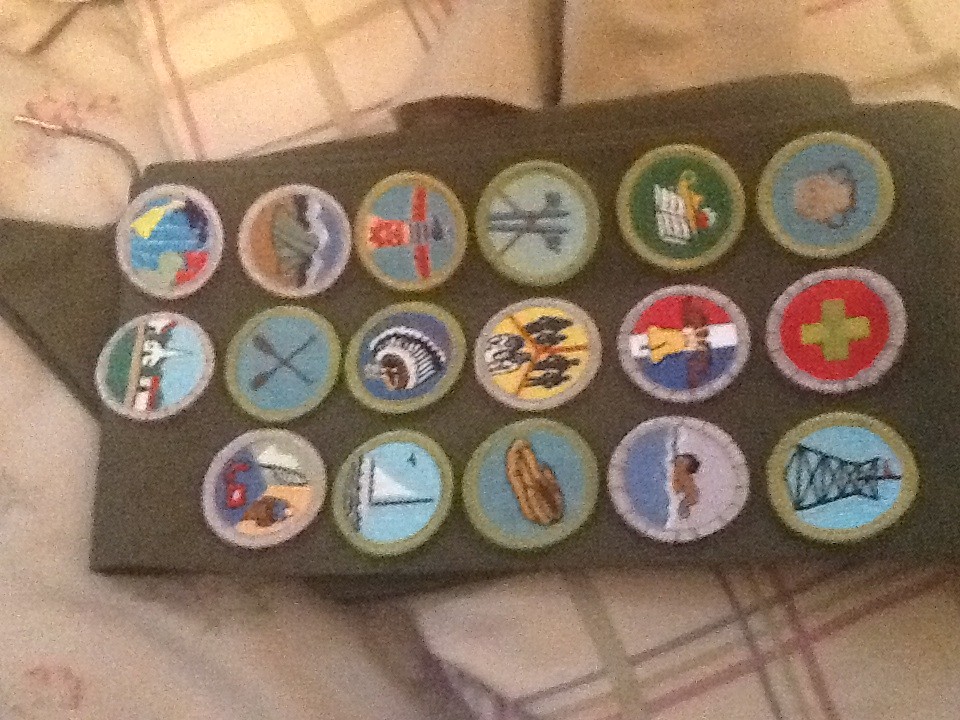
Merit Badges I earned: Pottery, First Aid, Pioneering, Reading, Citizenship in Nation, Swimming, Skiing, Family Life, Leatherwork, Woodworking, Indian Lore, Sailing, Camping, Canoeing, Communication, Citizenship in World, Citizenship in community.
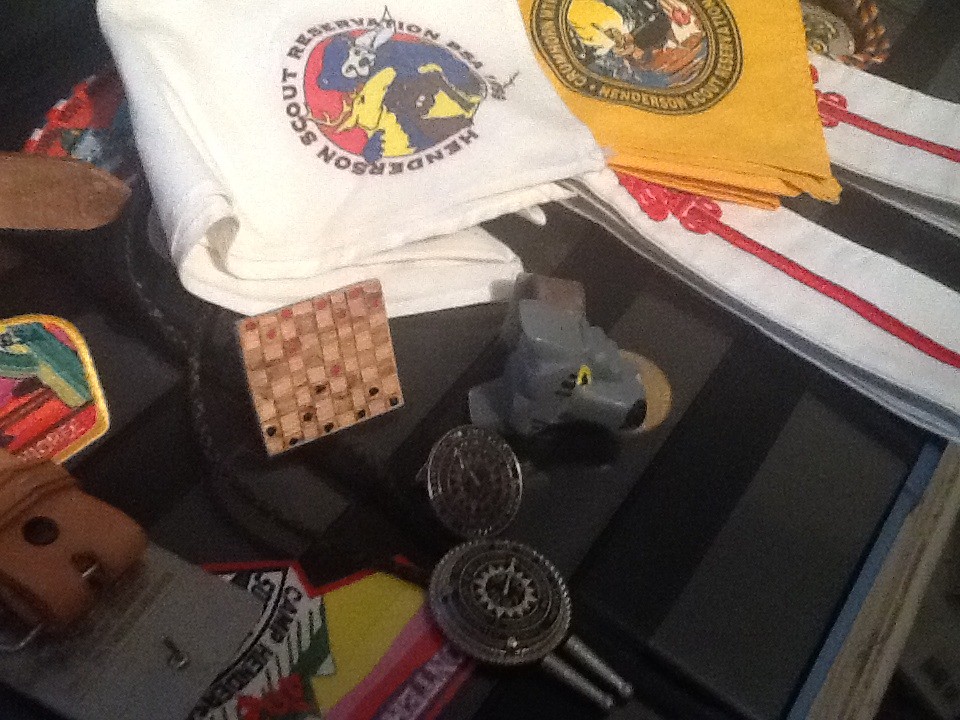
Neckerchiefs and Neckerchief slides. I made the wolfs head for the carving merit badge. The other one was for being undefeated in checkers at one week of scout camp. The bolo tie and the slide above it I bought for National Jamboree.


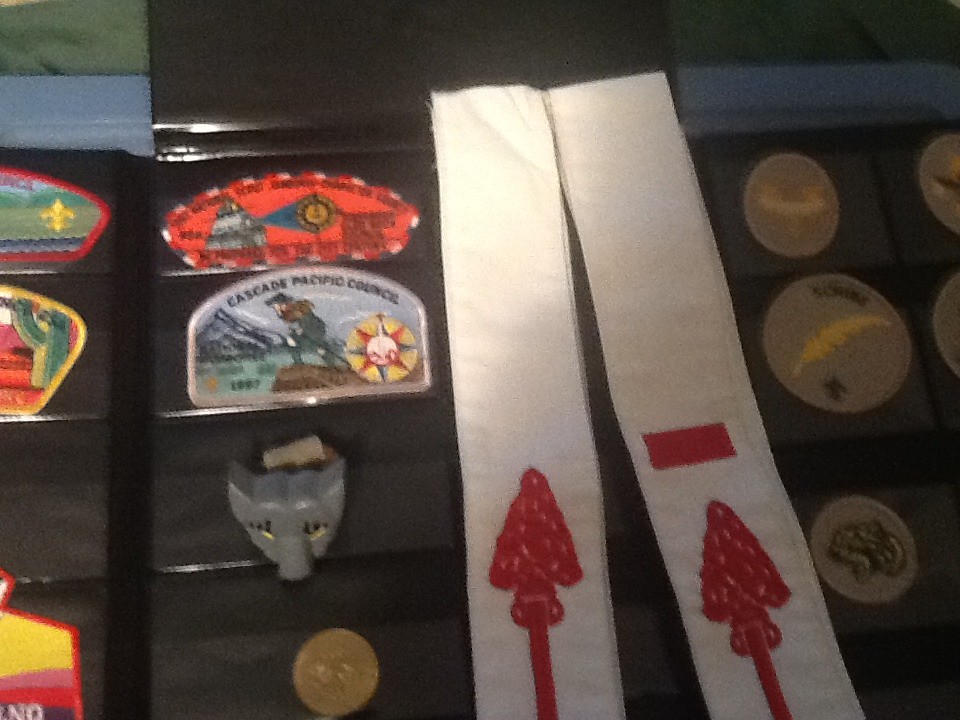
Shoulder patches I got by trading at the National Jamboree.  The white sashes were for the Order of the Arrow. The bar on the second one indicates the rank of brotherhood.  Note the orange R2 D2 shoulder patch.


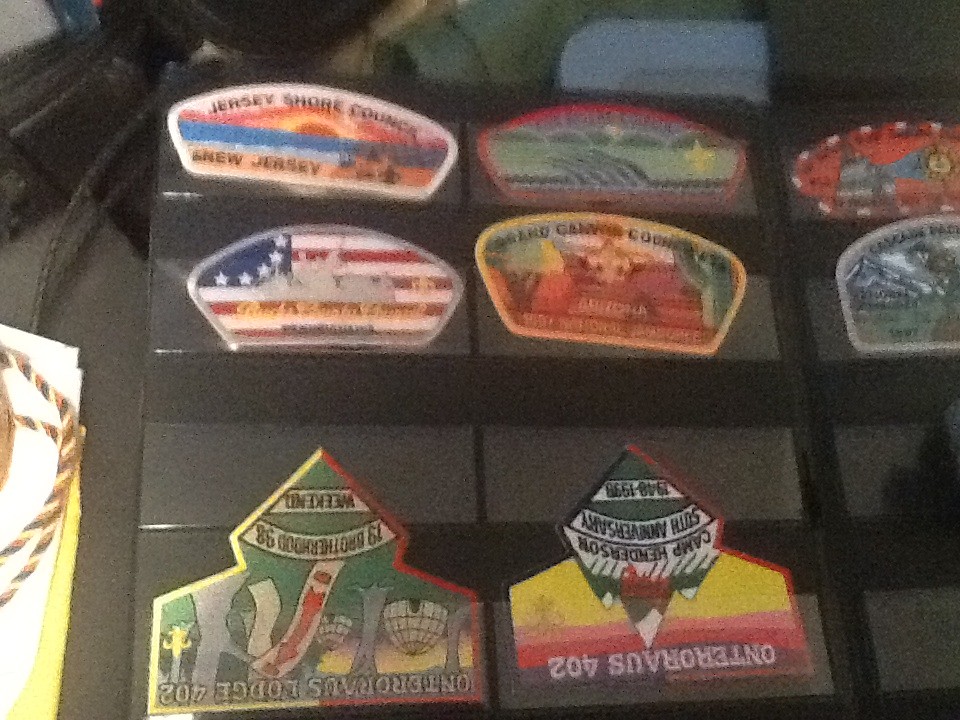
More shoulder patches from the National Jamboree. I wonder what the Jersey Shore Council thinks of the show. The bottom two patches were part of some sort of Council commemoration event, of which there were four that were designed to look cool when you put them all together.


November 18, 2012

Not Everyone Should Be Asked to Be Thankful

One of Mark Twain's more interesting pieces for me is his short story War Prayer, which asks a very interesting question. When we ask for victory in war, what are really asking for? For when one thinks of ones country being victorious in war, we very rarely think of the consequences, for the lives lost, the blood shed, or the psychological wounds that are created by war.

I would like to ask with this article, a question that might seem unrelated, but I think is very much in the same vein as Twain's question. When we give thanks, what are we really giving thanks for? For example, when we give thanks for the food we have, do we think of the possible workers who may have been exploited in the name of corporate profits, so that we may have that food?

Make no mistake, I am grateful for what I have. I know my current situation, while far from ideal, could be worse.

But this is going to be the first Thanksgiving I will be celebrating following the death of my Aunt Janine from breast cancer. She had been first diagnosed shortly before I graduated college. The first instance was eventually beaten into remission. Then two years later, the cancer came back.

This was last year, several months before Thanksgiving. Not knowing the exact situation, I sent an email to her, asking if it would be okay if I were to come down to their place on Long Island to cook Thanksgiving dinner there myself.

She emailed me back informing me that the cancer was terminal. I remember wanting to send something, to make some final statement to her. I didn't want to call because I was afraid of interrupting some valuable rest time. I wanted to send an email but frequently ended up finding myself staring at a blank computer screen, unable to write anything.

It turned out that Thanksgiving was the last meal that Aunt Janine was able to eat solid food. She passed away several days later.

This past October, which happens to be Breast Cancer Awareness Month, I found myself reading about Pinksploitation and how slapping a pink ribbon on everything allows some corporations to wrack up large profits while continuing to use known carcinogens in their products.

I don't know what I should be thankful for in this situation. I just think it needs to be said that not every cloud has a silver lining. There really are certain situations that are just plain awful.

Yes, I know the dangers of overly negative thinking as well as anyone. I am very aware how giving into negative feelings can cause one to lose all hope. I know how easily despair can bring one's life to a grinding halt. Being depressed or sick sucks, but stigmatizing those who are mentally ill or otherwise unhealthy, by making them feel guilty for their feelings or telling them that there is something "wrong" with them solves nothing. I refuse to tell someone they have to feel better about their own situation and that they should therefore focus on and be grateful for those things that they do have.

I know as an exercise, that it can be useful to focus one's thinking on the good things one has to help oneself feel better. But about a month ago, I was in a situation that made me feel very, well, depressed. I found myself thinking of the things I did have and as a result, found myself becoming even more depressed over the situation. Why, when I have all these good things in my life, should I be depressed? Surely there must be something wrong with me for *being* depressed when I do have so much to be thankful for.

It was only after I came to the realization, that hey, there really is nothing wrong with me for being depressed, that I started to find myself (oddly enough) feeling better. Telling myself that I was not to blame for being sad and upset was what allowed me to feel better. It was not thinking about the good things I have which enabled me to break out of the period of depression I found myself in.

As far as LGBTQ rights go, I can say that I am somewhat grateful that as a nation we are making progress towards marriage equality. I am thankful that the state I live in (New York) has laws against employers discriminating on the basis of sexual orientation.

But I am not grateful for the fact that ENDA has not yet passed at the Federal level, nor am I happy about the fact that GENDA (legislation that would outlaw discrimination on the basis of gender identity) has languished for so long in New York State.

I am also not grateful for how the marriage equality movement has taken so much attention away from these important pieces of legislation or from other issues that so desperately need our focus.

I find it difficult to be grateful when organizations such as the Salvation Army continues to discriminate against the LGBTQ community or when organizations such as the Boy Scouts of America still send the message to our community's youth that there is something fundamentally wrong with with being queer.

I am frustrated that the struggles for civil rights of the Transgender and Transsexual communities continue to receive far too little attention and political action.

I can say that I am grateful that I have never experienced homelessness or been sexually assaulted but I refuse to give thanks to a world in which the condition of homelessness exists and in which rape culture is celebrated by the mainstream.

Ultimately, I think there is something problematic about a culture that only celebrates that which is positive and refuses to critically think about any possible shortcomings. "We ARE number one and you HAVE to be grateful for that" is not a great message to tell people who have terminal or long term debilitating illnesses, who are unemployed or living in poverty, who are marginalized, or who live in constant fear, be it from bigotry or the possibility of facing overt violence.

All I ask is that people give some real thought this year to what we are really giving thanks for.

July 17, 2012

Queer Issue: Why the BSA's "Don't Ask, Don't Tell" Policy Matters

Everybody should know by now of the homophobic "Don't Ask, Don't Tell" policy held by the Boy Scouts of America, so I won't spend time rehashing the history. Today the BSA put out a press release, describing a secret committee that they put together for the purpose of "evaluating" said policy. In short, the discriminatory "Don't Ask, Don't Tell" is here to stay.

There are those, such as Alvin McEwen, who will argue that the policy does not matter, that it is not worth the LGBTQ community fighting. To this I must strongly disagree. The BSA's policy does matter and it does have a negative impact on the LGBTQ community, particularly the youth.

I was a member of the Scouting movement until I turned 18. I came within a few merit badges short of earning the rank of Eagle Scout, which less than 2 percent of all scouts who enrolled in the program complete. In Troop 16 I eventually ended up serving as Senior Patrol Leader, which is essentially the youth leader of the troop. I was also inducted into the Order of the Arrow, Boy Scouts honor society.

Even though as a youth I had known for years about my sexual orientation, I stayed in the closet until I turned 18. My reasoning for doing so had a great deal to do with the Boy Scout's "Don't Ask, Don't Tell" policy.

Hiding ones identity always comes with a cost. During my senior year of high school, I worked diligently on completing the final requirements for the rank of Eagle Scout. Deep down, part of me wanted to spite the BSA. To say, "Ha, Ha, you're wrong, we are just as good as you."

It was during my senior year of high school that the hiding took it's toll. The mental dissonance that comes from being told a constant message of "you are inferior, get lost freak" from all authorities wore at me until I finally broke.

While I was in the middle of working on my Eagle Scout Project (which consisted of repairing an old storage shed at the Methodist Church I attended) I attempted to commit suicide.

On the second day of the project, while my mom went to church, I played hookie so I could have some time alone. I got a knife from the kitchen and attempted to slice my wrists.

If there is one thing I am really grateful for being lousy at, it is committing suicide. My mom came home to find me on the kitchen floor, knife in hand. I ended up wearing a baggy long sleeved shirt to cover up the scratches I had made on my wrist. Somehow I managed to complete the Eagle Project, although I would later be unable to finish the requirements for the Eagle Rank itself.

Which brings me to the crux of the matter. No one can tell me that the BSA's policy is not harmful to LGBTQ youth. No one can claim that the message it sends is not without consequences.

While there are signs that things may actually be getting better, LGBTQ youth continue to face bullying and harrassment based upon their sexual orientation. There is no doubt in my mind that the BSA's policy encourages and empowers the bullies in these situations.

Consider as well, the influence the BSA holds in rural areas (such as Upstate New York where I grew up) where LGBTQ organizations are going to be few and far between. It is vital that LGBTQ youth have access to organizations that do tell them that they matter, that their lives are no less than those of their straight counterparts.

When an organization as influential as the BSA tells LGBTQ youth the opposite, that their lives mean less and that it is okay to discriminate based upon sexual orientation, something has to be done.

I'm not going to argue that the LGBTQ community should work towards repealing the BSA "Don't Ask, Don't Tell" policy. That's not the issue I want to bring up. But we cannot allow the BSA to go unchallenged in this issue. Whether this means transforming the BSA into an organization that does not discriminate or by providing viable alternatives in every community across the nation, is another matter.

What does matter is that the BSA's policy exacts a steep price and it is the youth of our community who pay it.

November 27, 2011

Queer Issue: When Good Charities/Organizations Go Bad.

It's that time of year again and probably most people reading this have heard the ringing of bells for the Salvation Army. Most people probably even dropped in their lose change or maybe some dollar bills.

What many people who are donating might not realize is that the Salvation Army has a long and sordid history of discriminating against homeless and disenfranchised queer individuals as well as actively pushing for anti-queer legislation, a history that can be read about here. PFLAG of Genesee County and other organizations have engaged in boycotts of the Salvation Army because of their discriminatory policies.

The thing is, the Salvation Army is not the only charity/organization that does good deeds while otherwise promoting bigotry. Catholic Charities for example, has been in the news recently for discriminating against same sex couples and unmarried couples in their adoption programs. Much like the Salvation Army, this is an addition to promoting homophobic policies within their organization.

See also:
- Illinois, Catholic Agencies At Odds Over Gay Adoptions
- Illinois’ Catholic Charities Lose Right To Discriminate Against Same-Sex Couples
- Catholic Charities chooses worst option for complying with DC law...and pretends it has no choice
- Same-sex marriage leads Catholic Charities to adjust benefits

Another homophobic organization is the Boy Scouts of America and their bigoted Don't Ask, Don't Tell policy regarding sexual orientation. I can recall when I was in the BSA collecting food for a local food pantry and participating in a high-way cleanup where we picked up liter on a section of I-88.

Yet the BSA's DADT policy is one that is very harmful for queer youth. During my senior year of high-school, while working on my Eagle Project to achieve the highest rank that the BSA offered, I attempted suicide. My reasons had everything to do with having been forced into the closet as a result of the BSA's homophobic policy.

Now I can already hear the protests of but these organizations do good things! they feed the homeless! they provide structure and activities for youth! they rescue kittens and puppies from burning buildings! and so on...

Yes... true. But any organization that discriminates against a particular group is reinforcing bigotry and the long term effects of bigotry pretty much always include increased poverty, homelessness, suicide, delinquency, and more for the individuals against whom that bigotry is directed. In other words, charities that actively discriminate against minorities are not merely denying services to those minorities, they are contributing to a broken culture that helped to create the problem in the first place. Furthermore, any support of these organizations by outside individuals does exactly the same.

In the long run, it is better to give to and support organizations that do not practice discrimination as these organizations will have a much better effect at actually solving "the problem" (whatever "the problem" may be).

Here are a few examples worth drawing attention to:

Goodwill
Doctors Without Borders
American Red Cross
Ruth Ellis Center
Sylvia Rivera Law Project

Local Organizations for Oneonta/New York State:

- Berkshire Farm Center and Services for Youth and their LIFE House Program Oneonta
(runaway and homeless youth, foster care/adoption, various other youth related services)

- Habitat For Humanity Otsego County
(Housing)

- Oneonta Community Health Center
(Free Health Services for the Uninsured)

- Positive Connections: An HIV/AIDS support network in Upstate New York.