The Imitation Game
Director: Morten Tyldum
Writers: Graham Moore. Based on the book Alan Turing: The Enigma by Andrew Hodges.
Cast: Benedict Cumberbatch, Keira Knightley, Matthew Goode, Rory Kinnear, Allen Leech, Matthew Beard, Charles Dance, Mark Strong, James Northcote, Alex Lawther, Jack Bannon
Overview
Thankfully The Imitation Game does not fall prey to the tendency of filmmakers to de-emphasize a heroic LGBTQ historical figures sexual identity. What we do get is a powerful, well made film about one of the more ironic chapters of human history. Alan Turing's work was influential in the fields of Mathematics, Philosophy, and Cryptology and he is considered the Father of Computer Science. His work on codebreaking is credited by historians has potentially having shortened the World War II, thereby saving countless lives. However, his ultimate fate might not have been very different had the Axis powers won that great conflict.
Synopsis
Alan Turing (Benedict Cumberbatch), one of the most talented mathematicians of his time, applies to Bletchley Park (the British center tasked with decoding German communications during World War II. He is accepted and immediately makes enemies with his immediate supervisor and coworkers due to his abrasive personality and his idea that a new kind of machine is necessary to break the German encoding device known as Enigma. As Turing puts it, it will "take a machine to break a machine". Further complications occur when Turing attempts to hire a talented female mathematician, Joan Clark (Kiera Knightly), to help with the decoding efforts, only to have her face severe sexism that hinders the contributions she can make. Eventually, Turing is successful in building the first decoding Machine (which he dubs Christopher after a childhood love) and ultimately aiding the Allies in their eventual victory over Germany.
This does not prevent Turings' inevitable fate when he confesses to having sexual relations with another man and is forced to participate in hormone therapy or go to jail.
The Queering
When I was growing up, my mom refused to allow us a TV and thus the two of us would frequently listen to audiobooks as a form of communal entertainment instead. While I have not (as of this writing) seen the 2001 film Enigma (an alternative version of the Bletchley Park story where Alan Turing was written out and replaced with an entirely heterosexual character), I do clearly recall listening to the audio book with my mother. I do remember that the tale that was told was one of a sweeping romance where the hero and his lover must face impossible odds while working against impossible odds to break the German codes.
Such is the history that a homophobic society would have us believe, one in which queer people simply do not exist but as victims or villians. This is how our history is stolen from us, not merely by presenting only the stories of us as monsters or victims, but by presenting the lives of our heroes as if they themselves were straight.
There is a vocal group of critics who will leap upon any historical inaccuracy in a film which deviates from history in even the smallest of details. Similarly, justification for homophobic language is simply given as "well, that's just the way people talk". However, when films present a LGBTQ character as heterosexual and/or cisgender, then the result is typically nothing more than a deafening silence.
In The Imitation Game there are a few deviations from history, mostly around simplifying the work being done at Bletchley Park and with how the decoding of the Enigma machine was actually used by the Allies. But these generally do not detract from the narrative, other than in one particularly contrived case where one of the codebreakers, after the decoding is first accomplished, reveals that one of his relatives is on part of a group about to be attacked, and the team must make the contrived decision to allow German attack to be carried out, rather than risk revealing to the Germans that Enigma has been broken. It's a small misstep, but it happens at a time when the film should be soaring.
Other deviations include making Turing to be more anti-social than he probably was. While the real Turing was indeed eccentric, he is written as if Graham Moore believes Turing to be a high-functioning autistic (allow me to insert the obligatory "not that there is anything wrong with that" disclaimer here) and his caustic relationship with his co-workers. The only problem with this is that it causes Turing to come across at times as a pan-romantic asexual. The only thing that prevents such an interpretation, is Turing repeatedly identifying as "homosexual" and his eventual prosecution for sexual deviance. As it is, Turing is never shown engaging in a same sex relationship or any kind of romance as an adult.
In any case, what is demonstrated very well by the film is the way in which Turing's work as codebreaker, philosopher, and mathematician was influenced by his sexuality. The most obvious as presented in the film, was the how the death of Christopher Morcom, drove Turing to consider how machines themselves might be able to think and to store consciousness. Turing believed that it might be possible someday for them to store human consciousness. He also developed what is known as the Turing Test (also known as the imitation test or game), which is an artificial test to determine if a machine is "thinking". Another thing that is done well by the film is the presentation of Turing's philosophical work into the question of Artificial Intelligence. The framing sequence, where Turing is being interrogated by a detective, has the two debating the question at length.
What is equally interesting, is the double meaning that can be read into the title. Does the imitation game refer to the Turing Test or to the imitation that LGBTQ people are constantly forced into, when we must imitate the lives of cisgender, heterosexuals? Either could apply to the life of Turing, who became engaged to Joan Clarke while they were working together at Bletchley Park. Fortunately, the filmmakers go out of their way to make it clear, that while Clarke and Turing were very close friends, their relationship was not in anyway romantic but based upon both of them facing different, but parallel forms of discrimination. While I don't wish to take anything away from Turing, it is worth noting that despite modern stereotypes, computer programming was once primarily seen as being a woman's work, due to it's secretarial nature and the fact that it could be done at home.
However, the greatest irony of Turings' life is not one that is often addressed. The NAZI's themselves were of course notoriously homophobic and imprisoned many gay men in concentration camps, where numerous expirements were performed on them in order to determine a cure for homosexuality. Such experiments included castration. As it were, Alan Turings' eventual prosecution at the hands of the British might have been only slightly better than his fate would have been at the hands of the NAZI's. Thus, while Turing's work was instrumental to an Allied Victory during World War II, he was not able to fully enjoy the results of his work.
Further irony comes in the fact that Turings' case was not unique, in the years leading up to 9/11 and aftewards during the US led invasions of Iraq and Afghanistan, numerous translators specializing in Arabic and Farsi were let go from the US Military for violating DADT. Some have speculated that had they had not been fired, the US would have had a chance to prevent 9/11.
Benedict Cumberbatch gives an impressive performance as Alan Turring, and able support is provided by his costars Kiera Knightley and Mathew Goode. The scene where Turing committed suicide was filmed, but not included in the theatrical version. Turings' final fate thus is revealed by title cards. This is the correct choice in my opinion. While it is important to note the consequences that Turing faced for being gay, too many of stories told about us go out of their way to needlessly demonstrate how miserable being queer can be. As it is, the film ends on a bittersweet note, with scenes of Turing and his coworkers celebrating the end of World War II. This perhaps is the best thing that we should remember Turing, how his accomplishments changed our world for the better. How he died is important, but only because those who forget the past are condemned to repeat it, as historian George Santayana (who was either gay or bi) would have put it.
Recommendation
Highly recommended. This is no imitation of a great movie, it has the heart of the real thing.
The Rating
Four Stars out of Four.
Trailer
Want to find a review of a particular work? Check out the Title Index, the archive of all reviews posted listed alphabetically.
Showing posts with label DADT. Show all posts
Showing posts with label DADT. Show all posts
January 26, 2015


January 18, 2013
Queer Issue: Moving and Moving On
For the record, the next couple of weeks may see a slight decrease in the number of posts here. I'll give you all a hint:

That's right, I'm going to be moving. I'm going back to school to major in Criminology at Wilkes University where my current partner is currently teaching.
Of course this means that I'm now getting out all the stuff shoved away in closets, sorting it out and packing it in the boxes for the move.
This also includes all of my memorabilia from when I was a member of the Boy Scouts of America. Thanks to the Boy Scout's "Don't Ask, Don't Tell" policy, the end of my tenure with the BSA was not a happy one. To put it bluntly, it was a long misery infused descent into hell.
It's a difficult thing to put the situation I now face into words. The list of items that I accumulated over my 13 year involvement with the scouting movement is quite extensive.
There are the merit badges, various memorabilia from the National Jamboree I went to in 1997, my uniform, neckerchiefs, patches, and so on. Each one comes infused with memories, such as the neckerchief slide an adult leader carved for me when I went an entire week of scout camp undefeated at checkers.
However because of how things ended with the Boy Scouts, I've been tempted to just burn all of it.
I first started with the BSA when I was in 1st grade as a Cub Scout.
I can recall a baking contest, where my dad and I made a cake, constructed it into the shape of a truck, which won best in show. And by in the shape of a truck, I don't mean we baked a sheet cake and cut out a truck shape from that. That would have been too straightforward. I mean we actually used pieces of cake to sculpt a 3 dimensional a cake truck.
I have other memories of Cub Scouts of course. Of Pine-Wood Derbies, earning belt-loops, bug juice, and making arts and crafts at scout camp. I think my mom still has the ceramic pot holder I made one year.
A pine-wood derby is a competition where you race wooden cars on downward tracks. One way to make your car faster was by drilling a hole in the car and filling it with some kind of metal. This was legal as I recall as there was a total weight you couldn't go over. In any case, I definitely recall my mom not being too pleased when in a bout of enthusiasm while working on my Pine-Wood derby car, I managed to use an old-fashioned hand powered drill to put a hole an inch deep into the floor I was working in.
I can recall my first "real" camping trip as a Boy Scout, when true to the rules of the universe, it rained and rained heavily. As the night progressed, water crept gradually into the tent. Eventually, to stay warm, the three of us that were in the tent all ended up in the same sleeping bag. When we went to tear down the tent, I could push on the corner of one sleeping bag and watch the water ripples spread out across all three. I think in all my years with the BSA, there was only one or two camp outs that was not accompanied with copious amounts of H2O falling from the sky.
As a Boy Scout I was inducted into the Order of the Arrow (Boy Scouts Honor Society), went to the National Jamboree, served as Troop Scribe, Assistant Senior Patrol Leader, and eventually Senior Patrol Leader. I managed to earn the rank of Life Scout, the rank just below that of Eagle. Scoutings highest rank eluded me by only a handful of merit badges that I failed to earn, thanks in part to the mental decline I experienced before turning 18.
However, as time advanced and I started to struggle with my sexuality, I also started to hear more and more about the BSA's "Don't Ask, Don't Tell" policy. But much like the frog in a pot of water that was slowly heating up, I was in too deep and too ingrained to simply want out.
Of course, as I advanced from Weblo's to Boy Scouts this meant I had to keep my budding sexual orientation a secret. It was tempting to bail, and part of me wanted to, but I was too ambitious for my own good. I wanted so very desperately to be an Eagle Scout. So I stayed in the closet.
I am not someone who quits or gives up easily. My middle name is Lawrence, a name choosen because of the fact that my family is descended from the brother of Captain James Lawrence, who created the famous saying "Never give up the ship". It's a statement I have found a great deal of inspiration from. Once I had set my sites on becoming and Eagle Scout, I was not going to be deterred.
Naturally, this set me up for a deep and complicated internal conflict. I wanted to be an Eagle Scout and I could not do anything to jeopardize that. This meant I could not breath a word of what I was to anyone. No matter how hard things got, coming out simply was not an option.
But internalizing this conflict only caused to fester and to take on it's own life. While working on my Eagle Scout project, I attempted to commit suicide. In the months that followed I had what could be labeled a nervous break down. I was diagnosed with depression. One of the medications I took had side effects which included "fatigue" and "increased saliva production".
Basically this meant I spent much of my class time my senior year falling asleep and waking up when the bell rang with my face in a humongous puddle of drool. Teachers would sometimes wake me up sooner if I started snoring.
Things got so bad that I actually considered dropping out of high-school.
It did not have to be like that. I entered my senior year as a member of honor society, a 1340 SAT score, and while I was not a top member of my class, my GPA was respectable. I was taking one course which had the possibility of college credit (Science in Modern Society) and otherwise sailing high. I had spent the summer before visiting campuses and pouring over college catalogs trying to decide where I wanted to go after I graduated. I was accepted at Clarkson University but decided against attending due to my health issues. Instead, I decided to go to SUNY Oneonta and in the Fall of 2002, I started taking classes as a non-matriculated student.
Which brings me back to what started me on this topic, what the hell do I do with all the stuff that I accumulated over the years that I was a scout? Do I burn it? Throw it away? What exactly does one do with something that carries with it the memories of so many painful experiences?
But throwing away all of my BSA memorabilia would mean throwing away stuff that carries with it memories from a great deal of my formative years. Destroying this material would come very close to destroying a part of my life.
Yes, there was pain in the end, but there were a lot of good memories as well. I cannot forget the suffering I went through my senior year, any more than I can forget the more pleasant times spent playing card games around a camp fire.
That's right, I'm going to be moving. I'm going back to school to major in Criminology at Wilkes University where my current partner is currently teaching.
Of course this means that I'm now getting out all the stuff shoved away in closets, sorting it out and packing it in the boxes for the move.
This also includes all of my memorabilia from when I was a member of the Boy Scouts of America. Thanks to the Boy Scout's "Don't Ask, Don't Tell" policy, the end of my tenure with the BSA was not a happy one. To put it bluntly, it was a long misery infused descent into hell.
It's a difficult thing to put the situation I now face into words. The list of items that I accumulated over my 13 year involvement with the scouting movement is quite extensive.
There are the merit badges, various memorabilia from the National Jamboree I went to in 1997, my uniform, neckerchiefs, patches, and so on. Each one comes infused with memories, such as the neckerchief slide an adult leader carved for me when I went an entire week of scout camp undefeated at checkers.
However because of how things ended with the Boy Scouts, I've been tempted to just burn all of it.
I first started with the BSA when I was in 1st grade as a Cub Scout.
I can recall a baking contest, where my dad and I made a cake, constructed it into the shape of a truck, which won best in show. And by in the shape of a truck, I don't mean we baked a sheet cake and cut out a truck shape from that. That would have been too straightforward. I mean we actually used pieces of cake to sculpt a 3 dimensional a cake truck.
I have other memories of Cub Scouts of course. Of Pine-Wood Derbies, earning belt-loops, bug juice, and making arts and crafts at scout camp. I think my mom still has the ceramic pot holder I made one year.
A pine-wood derby is a competition where you race wooden cars on downward tracks. One way to make your car faster was by drilling a hole in the car and filling it with some kind of metal. This was legal as I recall as there was a total weight you couldn't go over. In any case, I definitely recall my mom not being too pleased when in a bout of enthusiasm while working on my Pine-Wood derby car, I managed to use an old-fashioned hand powered drill to put a hole an inch deep into the floor I was working in.
I can recall my first "real" camping trip as a Boy Scout, when true to the rules of the universe, it rained and rained heavily. As the night progressed, water crept gradually into the tent. Eventually, to stay warm, the three of us that were in the tent all ended up in the same sleeping bag. When we went to tear down the tent, I could push on the corner of one sleeping bag and watch the water ripples spread out across all three. I think in all my years with the BSA, there was only one or two camp outs that was not accompanied with copious amounts of H2O falling from the sky.
As a Boy Scout I was inducted into the Order of the Arrow (Boy Scouts Honor Society), went to the National Jamboree, served as Troop Scribe, Assistant Senior Patrol Leader, and eventually Senior Patrol Leader. I managed to earn the rank of Life Scout, the rank just below that of Eagle. Scoutings highest rank eluded me by only a handful of merit badges that I failed to earn, thanks in part to the mental decline I experienced before turning 18.
However, as time advanced and I started to struggle with my sexuality, I also started to hear more and more about the BSA's "Don't Ask, Don't Tell" policy. But much like the frog in a pot of water that was slowly heating up, I was in too deep and too ingrained to simply want out.
Of course, as I advanced from Weblo's to Boy Scouts this meant I had to keep my budding sexual orientation a secret. It was tempting to bail, and part of me wanted to, but I was too ambitious for my own good. I wanted so very desperately to be an Eagle Scout. So I stayed in the closet.
I am not someone who quits or gives up easily. My middle name is Lawrence, a name choosen because of the fact that my family is descended from the brother of Captain James Lawrence, who created the famous saying "Never give up the ship". It's a statement I have found a great deal of inspiration from. Once I had set my sites on becoming and Eagle Scout, I was not going to be deterred.
Naturally, this set me up for a deep and complicated internal conflict. I wanted to be an Eagle Scout and I could not do anything to jeopardize that. This meant I could not breath a word of what I was to anyone. No matter how hard things got, coming out simply was not an option.
But internalizing this conflict only caused to fester and to take on it's own life. While working on my Eagle Scout project, I attempted to commit suicide. In the months that followed I had what could be labeled a nervous break down. I was diagnosed with depression. One of the medications I took had side effects which included "fatigue" and "increased saliva production".
Basically this meant I spent much of my class time my senior year falling asleep and waking up when the bell rang with my face in a humongous puddle of drool. Teachers would sometimes wake me up sooner if I started snoring.
Things got so bad that I actually considered dropping out of high-school.
It did not have to be like that. I entered my senior year as a member of honor society, a 1340 SAT score, and while I was not a top member of my class, my GPA was respectable. I was taking one course which had the possibility of college credit (Science in Modern Society) and otherwise sailing high. I had spent the summer before visiting campuses and pouring over college catalogs trying to decide where I wanted to go after I graduated. I was accepted at Clarkson University but decided against attending due to my health issues. Instead, I decided to go to SUNY Oneonta and in the Fall of 2002, I started taking classes as a non-matriculated student.
Which brings me back to what started me on this topic, what the hell do I do with all the stuff that I accumulated over the years that I was a scout? Do I burn it? Throw it away? What exactly does one do with something that carries with it the memories of so many painful experiences?
But throwing away all of my BSA memorabilia would mean throwing away stuff that carries with it memories from a great deal of my formative years. Destroying this material would come very close to destroying a part of my life.
Yes, there was pain in the end, but there were a lot of good memories as well. I cannot forget the suffering I went through my senior year, any more than I can forget the more pleasant times spent playing card games around a camp fire.
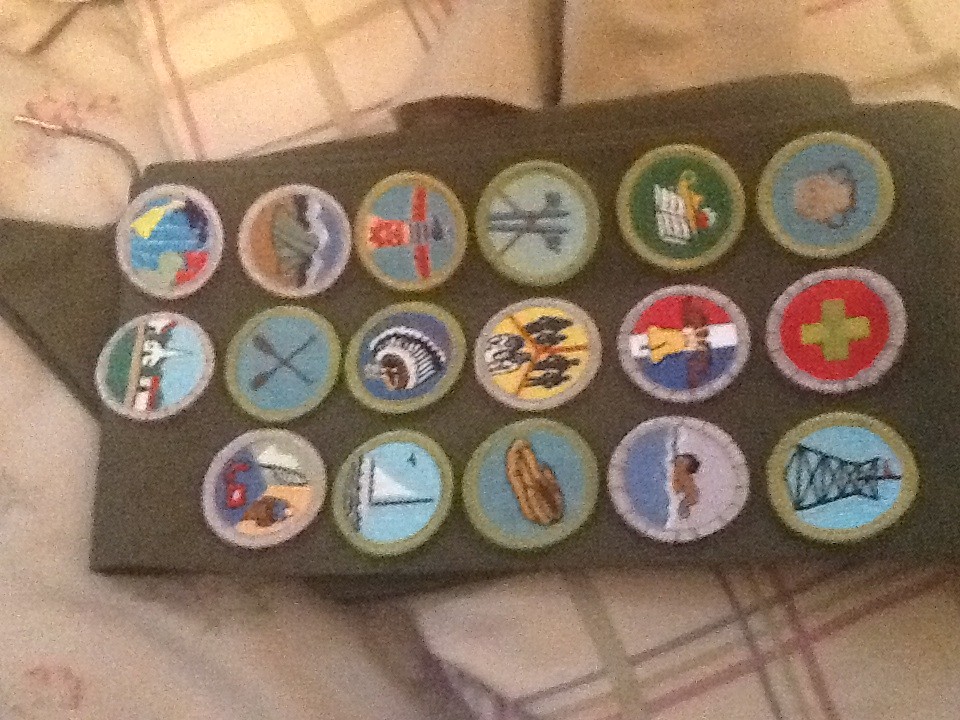 |
| Merit Badges I earned: Pottery, First Aid, Pioneering, Reading, Citizenship in Nation, Swimming, Skiing, Family Life, Leatherwork, Woodworking, Indian Lore, Sailing, Camping, Canoeing, Communication, Citizenship in World, Citizenship in community. |
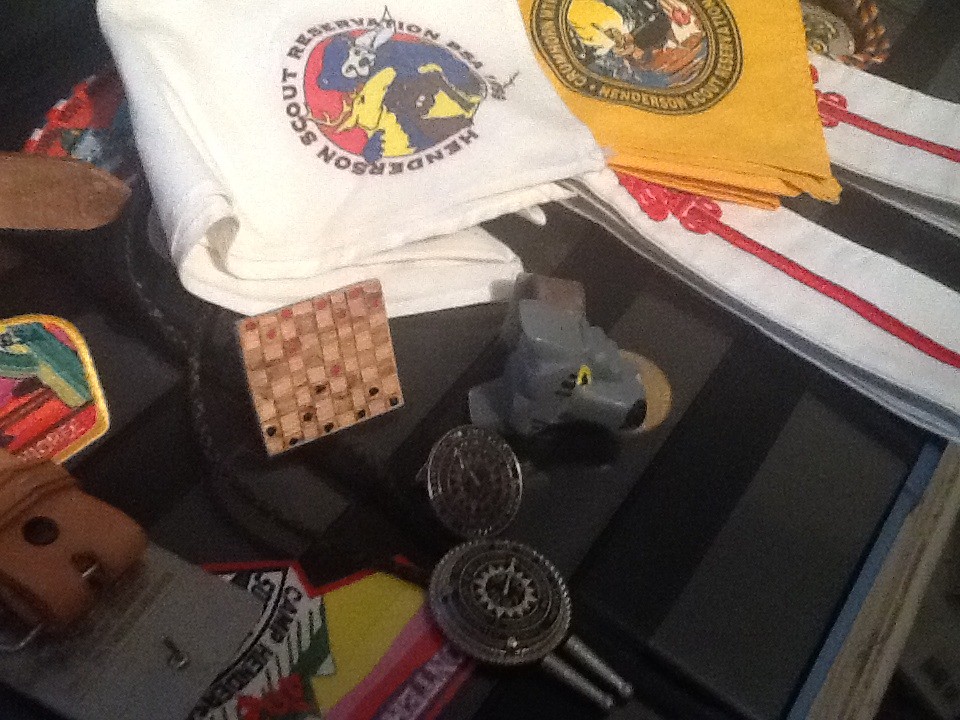 |
| Neckerchiefs and Neckerchief slides. I made the wolfs head for the carving merit badge. The other one was for being undefeated in checkers at one week of scout camp. The bolo tie and the slide above it I bought for National Jamboree. |
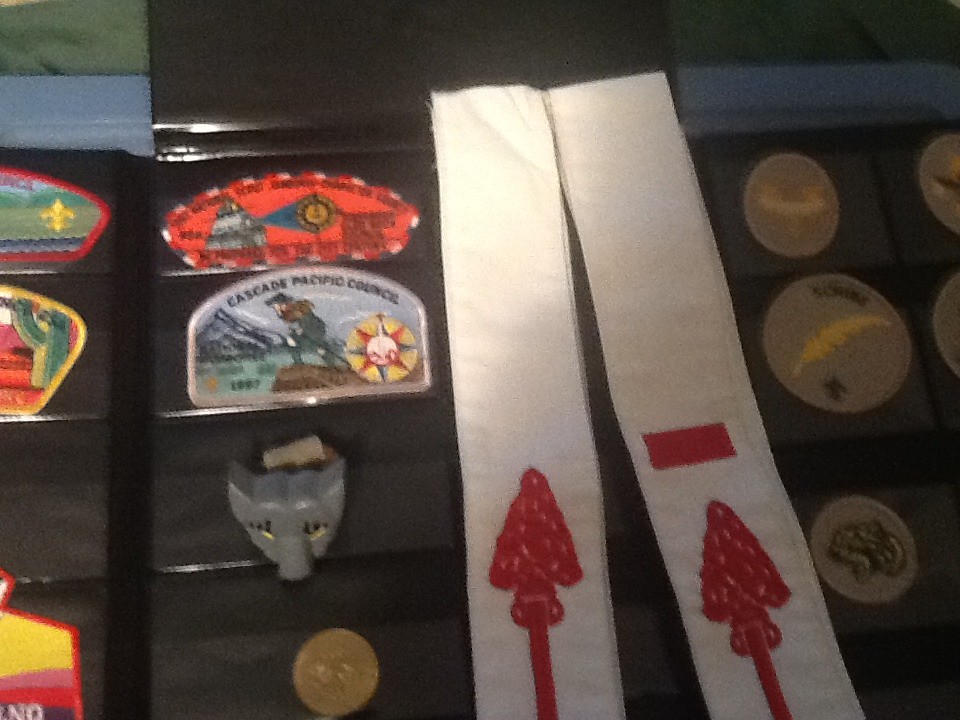 |
| Shoulder patches I got by trading at the National Jamboree. The white sashes were for the Order of the Arrow. The bar on the second one indicates the rank of brotherhood. Note the orange R2 D2 shoulder patch. |
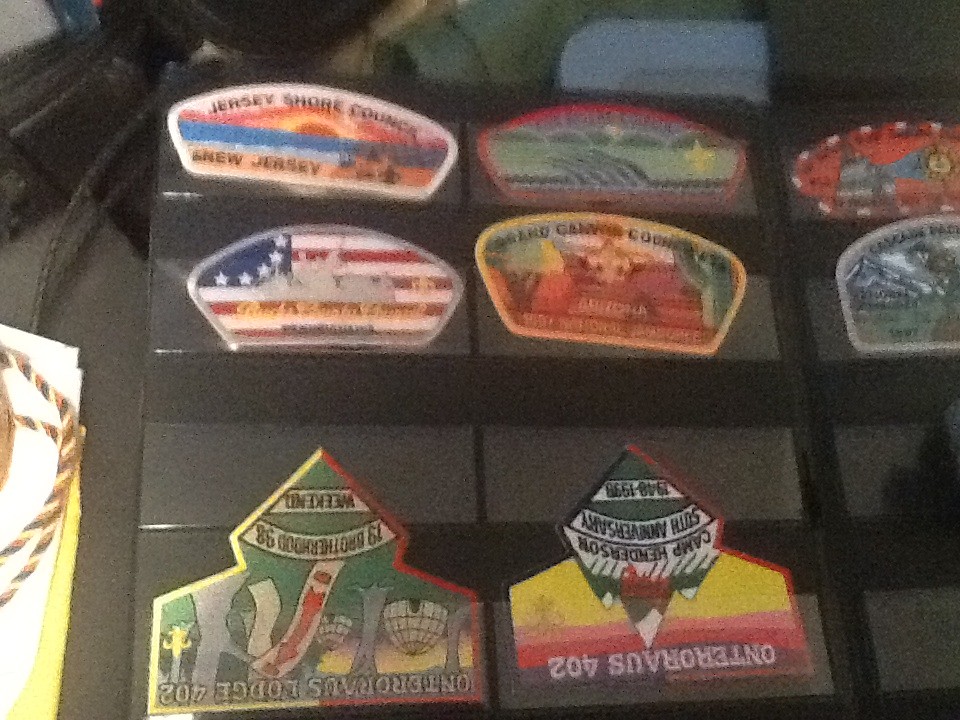 |
| More shoulder patches from the National Jamboree. I wonder what the Jersey Shore Council thinks of the show. The bottom two patches were part of some sort of Council commemoration event, of which there were four that were designed to look cool when you put them all together. |
June 2, 2012
Resistance is not Futile! How the seeking of same sex marriage goes against Unitarian Universalist principles.
Editors Note: The following is the content of a service I plan on delivering to the Unitarian Universalist Society of Oneonta as part of a PFLAG Oneonta/Otsego sunday service.
.......
First, a disclaimer. I would like to make it clear, that the opinions I am about to voice are my own and are not intended to represent the opinions or views of anyone else including Pflag Oneonta/Otsego. For the purposes of this sermon, it would be best to think of me as a generic queer activist and not as the president of Pflag Oneonta/Otsego.
In past 10 to 20 years, the topic of marriage equality and the push to repeal don't ask don't tell have come to be the two defining issues of the LGBT liberation movement. In particular, marriage equality has come increasingly to dominate the national discourse. However, same sex marriage was not always a primary goal of queer liberation. In fact, one detail that has become somewhat lost to the anals of history, is that early queer liberation was in fact focused on the elimination altogether of state sanctioned marriage, not for the inclusion of same sex couples within the institution. Early queer liberation was also radically anti-war and anti-imperialism.
As we have seen from the readings, same sex marriage has long been a traditional form of marriage. In addition to the Biblical King David and Johnathon, committed same sex couplings have been documented throughout history and throughout world cultures.
As for don't ask, don't tell, consider this.
Frederich Wilhelm von Steuben, who organized and provided much needed disciplen the continental army under George Washington, did so after he was exhiled from his native Prussia for engaging in "improper" relationships.
Alexander the Great conquered, what was from the greek perspective, the known world, while remaining a devoted lover to Hephestion.
Ernst Rohm was the founder and head of the NAZI stormtroopers. However, Adolf Hitler did not have Rohm assissignated in 1934 for being openly gay but because of the grave threat Hitler felt Rohm posed to Hitler's rule.
Oda Nubunaga, not only conquered most of Japan, but also lead the building the fortress Azuchi, which was the first able to repeal attacks from Western enchroachment. When Nubunaga was killed, it was at the side of his male lover, Mori Ranmari.
And there are many more examples I could cite here.
Thus the repeal of don't ask, don't tell, and the legalization of same sex marriage cannot be described as the implementation of radical new ideas, but the restorations of what have almost always been the case.
Thus, marriage equality and the repeal of don't ask, don't tell, are by definition, conservative movements.
As the conservative movements for marriage equality and don't ask, don't tell have come to dominate the national scene, many other voices and perspectives have become increasingly marginalized. In response, certain queer activists, calling themselves anti-assimilationists, have become progressively vocal in their efforts to oppose the push by mainstream LGBT organizations to legalize same sex marriage. One of the larger groups that I am aware of is Against Equality.
I personally was first exposed to the anti-assimilation movement by my boss when I was working at the Gender and Sexuality Resource Center at SUNY Oneonta, Robin Nussbaum, who lent me her copy of That's Revolting: Queer Strategies for Resisting Assimilation edited by Mathilda Bernstein.
Within the pages of that book, I was exposed to perspectives that I never had before considered. That's Revolting had a profound impact on how I came to comprehend and understand modern queer theory. I can't say that I agreed with everything that was written, but the articles within were memorable and persuasively argued.
Following reading "That's Revolting" I came to question as well, the wisdom of seeking the legalization of same sex marriage. In fact, I would now strongly argue that the seeking of state sanctioned same sex marriage goes against our Unitarian Universalist Principles.
As Unitarian Universalists, we uphold the notion that all people have inherent dignity and worth. However, state sanctioned marriage upholds that those people in certain specific (that is heternormative, monogamous) relationships are more valid and more worthy, than those individuals who are not. As marriage, an economic, social, and political institution, does in fact grant specific benefits to those who are married, while withholding those benefits from the unmarried, it ultimately degrades the dignity and worth of the unmarried.
What then of those who are in open or polyamorous relationships? As Unitarian Universalists, do we believe that certain relationships, based upon religious or societal conventions, are superiour to others? My understanding is that as Unitarian Universalists we should hold all healthy relationships to be sacred, not those that fall within the confines of heternormative monagomy. But by seeking same sex marriage, we are subtly, but undeniably, excluding the sacredness of relationships that do not fall within that narrow model.
Even if state sanctioned marriage was expanded to include all committed relationships, such as open or polyamorous relationships, what then of those who choose, for whatever reason, to remain single or unmarried? As Unitarian Universalists, would we claim that there is something wrong with those who chose of their own free will to remain single or that such individuals are of inherently less worth and less deserving of dignity than those in committed relationships?
Why should any single or unmarried person be denied the benefits of marriage, such as the easier access to healthcare and housing, that can come from being married? Would it not be better for queers, the anti-assimilationists argue, to seek universal healthcare, rather than same sex marriage? Should not the benefits of marriage be offered to all?
Furthermore, the movement for state sanctioned marriage ignores the deeper problems facing the queer community and pushes further discrimination upon those who are the most marginalized.
The transgendeer and transsexual population in particular face greater rates of discrimination when it comes to employment and access to housing. But in NY State, while we have anti-discrimination legislation that protects individuals against discrimination based upon sexual orientation, as well as marriage equality for the LGB community, we do not have any legislation that protects individuals from being fired from their jobs or being denied housing based upon their gender identity. GENDA, the legislation which would do this, is currently locked up in committe, and has little of hope of passing.
Homelessness is rampent amongst queer youth. New York City Mayor Bloomberg has endorsed marriage equality, earning him praise from pro-LGBT advocacy groups, who seem more than happy to ignore the fact that he cut 7 million dollars in funding for the Ali Fourney Shelter that serves homeless queer youth in New York City.
In Illinois, Lambda Legal announced a new campaign to fight for marriage equality. At the same time, the latest Illinois state budget cuts 3.3 million (or 42%) to the states fund for HIV programs related to community prevention, care and housing for those infected with HIV.
These examples are but the tip of an iceberg. There is no denying that ultimately, the push for state sanctioned marriage equality benefits the more fortunate and wealthy of the LGB community, while further marginalizing those queers who already face the greatest amounts of violence, discrimination, and poverty.
In our own community, the city of Oneonta, we have an ordinance that bans more than 3 unrelated individuals from living in a rental unit. This may not appear to be a queer issue but it is. For here we are faced with the issue of government sanctioned benefits, which make access to housing easier for the married and more difficult for those individuals living in circumstances the government has deemed as less worthy. If a rental unit can safely house 4 related people, why cannot it not safely house 4 unrelated people? How is overcrowding occuring in the latter circumstance but not the former?
Housing and healthcare, are both necessities, not friviolous wants. By making access to healthcare and housing more difficult to for those who are unmarried and by continueing to claim that the 1000 plus rights that come with marriage are only for those who are willing and able to committ to marriage, we deny the inherent dignity and worth of those human beings who are single or unmarried.
This is why, as Unitarian Universalists, I believe we should be devoting our social justice advocacy efforts to fight against the concept of state sanctioned marriage. We should not be content to merely expand the boundries of discrimination that come with state sanctioned marraige. Unitarian Universalists have long been the leaders of progressive movements, but by advocating for the conservative position of marriage equality, we are in fact falling dangerously behind the curve.
.......
First, a disclaimer. I would like to make it clear, that the opinions I am about to voice are my own and are not intended to represent the opinions or views of anyone else including Pflag Oneonta/Otsego. For the purposes of this sermon, it would be best to think of me as a generic queer activist and not as the president of Pflag Oneonta/Otsego.
In past 10 to 20 years, the topic of marriage equality and the push to repeal don't ask don't tell have come to be the two defining issues of the LGBT liberation movement. In particular, marriage equality has come increasingly to dominate the national discourse. However, same sex marriage was not always a primary goal of queer liberation. In fact, one detail that has become somewhat lost to the anals of history, is that early queer liberation was in fact focused on the elimination altogether of state sanctioned marriage, not for the inclusion of same sex couples within the institution. Early queer liberation was also radically anti-war and anti-imperialism.
As we have seen from the readings, same sex marriage has long been a traditional form of marriage. In addition to the Biblical King David and Johnathon, committed same sex couplings have been documented throughout history and throughout world cultures.
As for don't ask, don't tell, consider this.
Frederich Wilhelm von Steuben, who organized and provided much needed disciplen the continental army under George Washington, did so after he was exhiled from his native Prussia for engaging in "improper" relationships.
Alexander the Great conquered, what was from the greek perspective, the known world, while remaining a devoted lover to Hephestion.
Ernst Rohm was the founder and head of the NAZI stormtroopers. However, Adolf Hitler did not have Rohm assissignated in 1934 for being openly gay but because of the grave threat Hitler felt Rohm posed to Hitler's rule.
Oda Nubunaga, not only conquered most of Japan, but also lead the building the fortress Azuchi, which was the first able to repeal attacks from Western enchroachment. When Nubunaga was killed, it was at the side of his male lover, Mori Ranmari.
And there are many more examples I could cite here.
Thus the repeal of don't ask, don't tell, and the legalization of same sex marriage cannot be described as the implementation of radical new ideas, but the restorations of what have almost always been the case.
Thus, marriage equality and the repeal of don't ask, don't tell, are by definition, conservative movements.
As the conservative movements for marriage equality and don't ask, don't tell have come to dominate the national scene, many other voices and perspectives have become increasingly marginalized. In response, certain queer activists, calling themselves anti-assimilationists, have become progressively vocal in their efforts to oppose the push by mainstream LGBT organizations to legalize same sex marriage. One of the larger groups that I am aware of is Against Equality.
I personally was first exposed to the anti-assimilation movement by my boss when I was working at the Gender and Sexuality Resource Center at SUNY Oneonta, Robin Nussbaum, who lent me her copy of That's Revolting: Queer Strategies for Resisting Assimilation edited by Mathilda Bernstein.
Within the pages of that book, I was exposed to perspectives that I never had before considered. That's Revolting had a profound impact on how I came to comprehend and understand modern queer theory. I can't say that I agreed with everything that was written, but the articles within were memorable and persuasively argued.
Following reading "That's Revolting" I came to question as well, the wisdom of seeking the legalization of same sex marriage. In fact, I would now strongly argue that the seeking of state sanctioned same sex marriage goes against our Unitarian Universalist Principles.
As Unitarian Universalists, we uphold the notion that all people have inherent dignity and worth. However, state sanctioned marriage upholds that those people in certain specific (that is heternormative, monogamous) relationships are more valid and more worthy, than those individuals who are not. As marriage, an economic, social, and political institution, does in fact grant specific benefits to those who are married, while withholding those benefits from the unmarried, it ultimately degrades the dignity and worth of the unmarried.
What then of those who are in open or polyamorous relationships? As Unitarian Universalists, do we believe that certain relationships, based upon religious or societal conventions, are superiour to others? My understanding is that as Unitarian Universalists we should hold all healthy relationships to be sacred, not those that fall within the confines of heternormative monagomy. But by seeking same sex marriage, we are subtly, but undeniably, excluding the sacredness of relationships that do not fall within that narrow model.
Even if state sanctioned marriage was expanded to include all committed relationships, such as open or polyamorous relationships, what then of those who choose, for whatever reason, to remain single or unmarried? As Unitarian Universalists, would we claim that there is something wrong with those who chose of their own free will to remain single or that such individuals are of inherently less worth and less deserving of dignity than those in committed relationships?
Why should any single or unmarried person be denied the benefits of marriage, such as the easier access to healthcare and housing, that can come from being married? Would it not be better for queers, the anti-assimilationists argue, to seek universal healthcare, rather than same sex marriage? Should not the benefits of marriage be offered to all?
Furthermore, the movement for state sanctioned marriage ignores the deeper problems facing the queer community and pushes further discrimination upon those who are the most marginalized.
The transgendeer and transsexual population in particular face greater rates of discrimination when it comes to employment and access to housing. But in NY State, while we have anti-discrimination legislation that protects individuals against discrimination based upon sexual orientation, as well as marriage equality for the LGB community, we do not have any legislation that protects individuals from being fired from their jobs or being denied housing based upon their gender identity. GENDA, the legislation which would do this, is currently locked up in committe, and has little of hope of passing.
Homelessness is rampent amongst queer youth. New York City Mayor Bloomberg has endorsed marriage equality, earning him praise from pro-LGBT advocacy groups, who seem more than happy to ignore the fact that he cut 7 million dollars in funding for the Ali Fourney Shelter that serves homeless queer youth in New York City.
In Illinois, Lambda Legal announced a new campaign to fight for marriage equality. At the same time, the latest Illinois state budget cuts 3.3 million (or 42%) to the states fund for HIV programs related to community prevention, care and housing for those infected with HIV.
These examples are but the tip of an iceberg. There is no denying that ultimately, the push for state sanctioned marriage equality benefits the more fortunate and wealthy of the LGB community, while further marginalizing those queers who already face the greatest amounts of violence, discrimination, and poverty.
In our own community, the city of Oneonta, we have an ordinance that bans more than 3 unrelated individuals from living in a rental unit. This may not appear to be a queer issue but it is. For here we are faced with the issue of government sanctioned benefits, which make access to housing easier for the married and more difficult for those individuals living in circumstances the government has deemed as less worthy. If a rental unit can safely house 4 related people, why cannot it not safely house 4 unrelated people? How is overcrowding occuring in the latter circumstance but not the former?
Housing and healthcare, are both necessities, not friviolous wants. By making access to healthcare and housing more difficult to for those who are unmarried and by continueing to claim that the 1000 plus rights that come with marriage are only for those who are willing and able to committ to marriage, we deny the inherent dignity and worth of those human beings who are single or unmarried.
This is why, as Unitarian Universalists, I believe we should be devoting our social justice advocacy efforts to fight against the concept of state sanctioned marriage. We should not be content to merely expand the boundries of discrimination that come with state sanctioned marraige. Unitarian Universalists have long been the leaders of progressive movements, but by advocating for the conservative position of marriage equality, we are in fact falling dangerously behind the curve.
May 30, 2011
Queer Issue: A Few Memorial Day Reflections on DADT and it's Repeal.
As of this writing, DADT repeal legislation has been passed by Congress but still has to be implemented and there is a whole bunch of shenanigans being done by homophobic politicians to prevent and make difficult that implementation.
Whatever. While I believe that repealing DADT was necessary, I never felt that it was the really huge victory that led to so much cheering and celebrating in the queer community. My reasoning for this view is two fold.
First, while I am not a complete pacifist, I am against the current occupation of Iraq and Afghanistan. This begs the question, does supporting the repeal of DADT, mean supporting the military occupations Iraq and Afghanistan? While I do not always agree with Mathilda Bernstein Sycamore, she does make a good argument that this is the case in "A Fine Romance: Democracy Now's Amy Goodman and Lieutenant Dan Choi"
Irregardless of whether or not supporting the DADT repeal would in fact equate to supporting the wars in Iraq and Afghanistan, there is a more pressing issue I want to talk about. While it is often perceived that we treat our veterans with only the respect and dignity that they justly deserve, the reality is actually a bit different. Let me put it bluntly, our country has a truly shitty history when it comes to the treatment of veterans. Not just kind of shitty, really, really shitty.
When I first started this article, I thought I was going to have to search high and low to find the data to back myself up on this. Frighteningly enough, I did not have to.
Let us start with something most people will have heard about, the Washington Post article, "Soldiers Face Neglect, Frustration At Army's Top Medical Facility" that uncovered the nightmarish conditions facing returning veterans at Walter Reed Army Medical Center. The article opens up with the following paragraph:
I tried to find information on whether or not conditions had improved at all since the Washington Post report was made in 2007, but failed. The Wikipeda article on the "Walter Reed Army Medical Center neglect scandal" only has information on a few administrators being fired and the government planning a review.
But the conditions at Walter Reed, whether they were fixed or not, is not the only issue. According to a government report by The Housing and Urban Development and Veterans Affairs departments:
Again, that is not all the damning information I was able to find. According to the Think Progress Twitter Feed @TPHealth:
Also, let me not forget the Time magazine article "Sexual Assaults on Female Soldiers: Don't Ask, Don't Tell" in which we get the following information:
To sum this all up, those that are cheering for the DADT repeal are arguably also cheering to allow LGBTQIA soldiers the chance to not only risk their lives serving their country, but for them to also face substandard medical treatment, greater difficulty in finding employment, an increased risk of homelessness, and for female soldiers, a greater chance of being raped. Ain't the DADT repeal just grand?
In all fairness, the public is often sold a much different image of the services provided to veterans then the reality of what really goes on. Memorial Day features a lot of patriotic flag waving, but almost no serious talk of the difficulties faced by veterans. At least none that I know about. I dislike public memorials for veterans because to me, they feel like ribbon cutting opportunities for politicians, that allow them to ignore the greater problems faced by veterans at a time when those politicians should be solving them. We owe it to those that have served our country in the military to understand their sacrifices and to see to it that they are treated properly upon their return from war. A couple of nice speeches and statues will not accomplish that at all.
WikiLeaks had a good quote from their article
"2011-05-30 Memorial Day in America: What the US Government Wants Americans to Remember vs. What WikiLeaks Thinks Should Be Remembered" to close this all out with:
Whatever. While I believe that repealing DADT was necessary, I never felt that it was the really huge victory that led to so much cheering and celebrating in the queer community. My reasoning for this view is two fold.
First, while I am not a complete pacifist, I am against the current occupation of Iraq and Afghanistan. This begs the question, does supporting the repeal of DADT, mean supporting the military occupations Iraq and Afghanistan? While I do not always agree with Mathilda Bernstein Sycamore, she does make a good argument that this is the case in "A Fine Romance: Democracy Now's Amy Goodman and Lieutenant Dan Choi"
In its eagerness to jump on the bandwagon in support of the repeal of Don't Ask Don't Tell, the antiwar left becomes complicit with US wars. These reporters can't get past their joy at finding a gay struggle to support, in order to step back and realize, wait: maybe this particular gay struggle is contrary to everything I supposedly represent. That's the nightmare of assimilation we're living in -- add "gay" to any reactionary goal, and the liberals will jump on the bandwagon, but the founding values of gay liberation -- fighting police brutality; challenging US imperialism; ending oppressive institutions like marriage and the military and organized religion; and creating personal autonomy for sexual merrymaking outside of conventional norms -- nope, we rarely hear anything about those queer values.
Irregardless of whether or not supporting the DADT repeal would in fact equate to supporting the wars in Iraq and Afghanistan, there is a more pressing issue I want to talk about. While it is often perceived that we treat our veterans with only the respect and dignity that they justly deserve, the reality is actually a bit different. Let me put it bluntly, our country has a truly shitty history when it comes to the treatment of veterans. Not just kind of shitty, really, really shitty.
When I first started this article, I thought I was going to have to search high and low to find the data to back myself up on this. Frighteningly enough, I did not have to.
Let us start with something most people will have heard about, the Washington Post article, "Soldiers Face Neglect, Frustration At Army's Top Medical Facility" that uncovered the nightmarish conditions facing returning veterans at Walter Reed Army Medical Center. The article opens up with the following paragraph:
Behind the door of Army Spec. Jeremy Duncan's room, part of the wall is torn and hangs in the air, weighted down with black mold. When the wounded combat engineer stands in his shower and looks up, he can see the bathtub on the floor above through a rotted hole. The entire building, constructed between the world wars, often smells like greasy carry-out. Signs of neglect are everywhere: mouse droppings, belly-up cockroaches, stained carpets, cheap mattresses.
I tried to find information on whether or not conditions had improved at all since the Washington Post report was made in 2007, but failed. The Wikipeda article on the "Walter Reed Army Medical Center neglect scandal" only has information on a few administrators being fired and the government planning a review.
But the conditions at Walter Reed, whether they were fixed or not, is not the only issue. According to a government report by The Housing and Urban Development and Veterans Affairs departments:
-- More than 3,000 cities and counties reported 75,609 homeless veterans on a single night in January of 2009; 57 percent were staying in an emergency shelter or transitional housing program while the remaining 43 percent were unsheltered. Veterans represent about 12 percent of all homeless people counted nationwide during the 2009 assessment;
-- During a 12-month period in 2009, about 136,000 veterans -- or about 1 in every 168 veterans -- spent at least one night in an emergency shelter or transitional housing program. The vast majority of sheltered homeless veterans -- 96 percent -- experienced homelessness alone. Four percent of homeless veterans were found to be part of a family. Sheltered homeless veterans are most often single white men between the ages of 31 and 50 and living with a disability;
-- Veterans are 50 percent more likely to become homeless compared to all Americans and the risk is even greater among veterans living in poverty and poor minority veterans. HUD and VA examined the likelihood of becoming homeless among American veterans with particular demographic characteristics and found that during 2009, twice as many poor Hispanic veterans used a shelter compared with poor non-Hispanic veterans. African American veterans in poverty had similar rates of homelessness;
Again, that is not all the damning information I was able to find. According to the Think Progress Twitter Feed @TPHealth:
Something to think about this #MemorialDay: 10.9% of Iraq & Afghanistan veterans are unemployed, 2 %points higher than national average
Also, let me not forget the Time magazine article "Sexual Assaults on Female Soldiers: Don't Ask, Don't Tell" in which we get the following information:
The Pentagon's latest figures show that nearly 3,000 women were sexually assaulted in fiscal year 2008, up 9% from the year before; among women serving in Iraq and Afghanistan, the number rose 25%. When you look at the entire universe of female veterans, close to a third say they were victims of rape or assault while they were serving — twice the rate in the civilian population.
To sum this all up, those that are cheering for the DADT repeal are arguably also cheering to allow LGBTQIA soldiers the chance to not only risk their lives serving their country, but for them to also face substandard medical treatment, greater difficulty in finding employment, an increased risk of homelessness, and for female soldiers, a greater chance of being raped. Ain't the DADT repeal just grand?
In all fairness, the public is often sold a much different image of the services provided to veterans then the reality of what really goes on. Memorial Day features a lot of patriotic flag waving, but almost no serious talk of the difficulties faced by veterans. At least none that I know about. I dislike public memorials for veterans because to me, they feel like ribbon cutting opportunities for politicians, that allow them to ignore the greater problems faced by veterans at a time when those politicians should be solving them. We owe it to those that have served our country in the military to understand their sacrifices and to see to it that they are treated properly upon their return from war. A couple of nice speeches and statues will not accomplish that at all.
WikiLeaks had a good quote from their article
"2011-05-30 Memorial Day in America: What the US Government Wants Americans to Remember vs. What WikiLeaks Thinks Should Be Remembered" to close this all out with:
American society does not remember the stories that soldiers like Ethan McCord [...] will live with for the rest of their lives. Society does not share the burden of memory that a soldier deployed in Afghanistan or Iraq experiences. It adorns yellow ribbons to the vehicles it drive around, awards medals to soldiers, offers minimal health care and ways to reincorporate into society upon return from deployment but little is done to give soldiers a public fora for expressing the anxiety, anguish, fear, pain or stress that a soldier brings back with him or her from a war zone.
Subscribe to:
Posts (Atom)