By now, the fact that the soon to be released Stonewall movie directed by Roland Emmerich minimizes the contributions of transgender women of color and that key figures such as Sylvia Rivera and Miss Major are entirely absent, is fairly well known.
However let's recap things briefly. While the film is yet to be released, and thus could look very different from the previews and promotional material, the signs are not currently all that promising. The main cast is mainly white and the trailer focuses on a white gay male character who appears to be responsible for (in the movie) actually starting the riots. Although, I never heard the version where a brick thrown threw a window was what started the riots, but um, okay.
Admittedly, the trailer could be misleading, and the cast, as billed, is not reflective of who actually gets to play major parts in the film. Also, there is a character listed as Marsha P. Johnson on the film's IMDB, which will mean that Marsha P. Johnson will be the second transgender woman of color to have a character based on her appear in a major motion picture. The first (that I am aware of) being Lady Chablis in Midnight in the Garden of Good and Evil.
I have often bemoaned the straightening out of historical LGB characters when they are presented on the silver screen. A process in which bisexual or pansexual characters will either be presented as engaging in only heterosexual copulings, or the same sex partners will be minimized or ignored. If they character was gay or lesbian, then they will either wind up bisexual on screen or straight, depending.
However, I have increasingly come to notice the actual absence of characters on film based on historical or real life transgender or transsexual people.
Thus I tried putting together a list of all mainstream feature films that actually featured such characters. Documentaries are excluded. Stories based on a real life story where the transgender character was fictional were also excluded (ie: Dallas Buyers Club).
Here is the list:
-Queen Christina (1933)
-The Christine Jorgensen Story (1970)
-Dog Day Afternoon (1975)
-Midnight in the Garden of Good and Evil (1977)
-Boys Don't Cry (1999)
Upcoming Movies:
-Stonewall (2015)
-The Danish Girl (2015)
I may be missing a few. I can't claim to be an expert on foreign films for example. And many early silent movies have been lost altogether. But even if there are a few examples that I'm missing, that's still a pretty pathetic list. If there are any, let me know, and I'll add them in.
But as it stands, of these examples, one is the story of a trans-man who ends up dead (Boys Don't Cry). Two are famous for primarily being transgender or transsexual (The Christine Jorgensen Story and Queen Christina. The remaining two characters are incidental to the main story (Dog Day Afternoon and Midnight in the Garden of Good and Evil).
Not that there is anything wrong with presenting the stories of tragedy within the LGBTQ or cases where the character is famous for being LGBTQ, but there needs to be a point where we move past that.
Consider as a point of comparison, the number of movies based on the lie of Ed Gein (who was not in any way transgender in real life), in which characters who were based on him (or his murder spree) are shown cross dressing or attempting to obtain sex change operations. There are 5 of them that I am aware of. (Psycho, The Texas Chainsaw Massacre, The Silence of the Lambs, and The X-Files: I Want to Believe.) Add in sequels and the Gus Van Sant Psycho remake, and these films easily outnumber the films featuring historical transgender characters.
It's worth pointing out that there isn't exactly an absence of historical transgender or transsexual people to tell stories about. The fact that Sylvia Rivera has never shown up in a mainstream film in spite of (almost now) two films about the Stonewall Riots, is itself disheartening.
A few examples:
-Alan L. Hart: Saved thousand of lives by innovating the use of x-rays in the diagnosis of tuberculosis.
-King Ashurbanipal: Developed one of the largest collection of cuneiform documents ever and had a card catalog to find material. In plain talk: He invented the library.
-Karen Ulane: Was fired by Eastern Airlines for undergoing gender affirmation surgery and sued the airline in court before dying an airplane crash.
-We'Wha: A famous Zuni Native American who met President Groover Cleveland.
-Lynn Conway: Computer scientist whose innovations are still used in modern computers and transgender activist.
-Chevalier d'Eon: French spy and member of the Secret du Roi.
-Elagabalus: Roman Emperor who developed such a scandalous reputation that he had damnatio memoriae (the erasure of a Roman's official public record and very rarely done) applied to him.
At the end of the day, it's important to note that the stories of people across the LGBTQ spectrum are told (this should go without saying right?). We are starting to see inroads being made with prominent films featuring cisgender LGB characters based on historical figures getting made and widespread distribution. The Imitation Game being the most recent example. However, the lack of portrayals of historical transgender or transsexual individuals on film (and arguably elsewhere) is an issue that needs to be rectified.
Showing posts with label queer issue. Show all posts
Showing posts with label queer issue. Show all posts
September 7, 2015


February 3, 2015
Queer Issue: The Box Trolls, Same Sex Parents, and the Never Ending Parade of Gender Transgressive Villains.
In the grand scheme of things, there are plenty of little details that can escape my attention. I didn't know until last night, for example, that the original teaser trailer for The Boxtrolls featured same sex parenting.
The trailer opens with an anonymous narrator intoning, "Sometimes there's a mother, sometimes a mother and a father, sometimes there's a father and a father, sometimes both fathers are mothers."
It appears then that the makers of ParaNorman (the first children's movie to feature an openly gay character) are still willing to continue pushing against homophobic boundaries.
This is a good thing.
Here is the trailer for those who are curious:
My partner and I watched The Boxtrolls the other night and while it at times evokes some of the better elements of ParaNorman, there were some other elements I want to comment on. I don't plan on writing a review, as I was watching it while playing on my laptop and thus was not fully paying attention to the film
The basic story revolves around Eggs, a human boy being raised by Boxtrolls, a sentient group of trolls who are vilified and hunted by the citizens of Cheesebridge. Thus it would appear that the references to same sex parenting in the teaser trailer are rather apt.
This too is good.
However, in a plot twist, it turns out that the head Snatcher (the group tasked with hunting down the Boxtrolls) is also a cross-dressing cabaret singer, who uses his secondary identity to help vilify the Boxtrolls via over the top theatrical performances.
This is not a good thing.
On one hand we are fortunately spared any over the top transphobic Ace Ventura-esque reactions. Eggs doesn't react much of all to the revelation, nor does any one else. And in what I think is a first, this is a first cross-dresser baddie who is shown stealing anything from any female characters. The closest he comes is trying to steal a truly feminine white hat from the mayor.
As it is, the White Hats (which represent the upper crust of Cheesebridge and are presented in the most fay terms possible) are what provide motivation to the Snatchers. As it is, the Snatchers work assiduously to join the ranks of the White Hats, and thus the Snatchers are the ones who spend the most time fanning the flames of hatred against the Boxtrolls.
There are definitely a few interesting subtexts regarding class roles going on here.
On the other hand, I am not sure what the point of the whole The-Head-Snatcher-Sometimes-Dresses-Up-Like-A-Woman sub-plot was. It does, however, do a pretty good job of reinforcing the idea that trans people are deceptive. In fact, deceptiveness is pretty much the character's defining character trait. When Eggs first shows up on the surface of Cheesebridge, and sees the Snatchers putting on his anti-Boxtroll propaganda piece, his immediate reaction to the drag performance is to label it as fraudulent.
In fact, Eggs attempting to reveal the head snatcher as a "fraud" pretty much sums up the rest of the movie. The final scene of the movie has Eggs exhorting the head Snatcher to "stay true to his own nature" and that it doesn't matter what the Snatcher wears or eats.
This is *not* a good subtext.
In fact, it's a pretty shitty subtext, precisely given the constant stream of transphobic rhetoric that transgender people should "stay true to their nature" and not try to live as the gender they identify as and instead live as the gender they were assigned by society.
Honestly, I don't know what more to say about all of this. ParaNorman was groundbreaking, and the same can be said about the trailer for The Boxtrolls. Too bad the actual movie The Boxtrolls delivers such a problematic message.
The trailer opens with an anonymous narrator intoning, "Sometimes there's a mother, sometimes a mother and a father, sometimes there's a father and a father, sometimes both fathers are mothers."
It appears then that the makers of ParaNorman (the first children's movie to feature an openly gay character) are still willing to continue pushing against homophobic boundaries.
This is a good thing.
Here is the trailer for those who are curious:
My partner and I watched The Boxtrolls the other night and while it at times evokes some of the better elements of ParaNorman, there were some other elements I want to comment on. I don't plan on writing a review, as I was watching it while playing on my laptop and thus was not fully paying attention to the film
The basic story revolves around Eggs, a human boy being raised by Boxtrolls, a sentient group of trolls who are vilified and hunted by the citizens of Cheesebridge. Thus it would appear that the references to same sex parenting in the teaser trailer are rather apt.
This too is good.
However, in a plot twist, it turns out that the head Snatcher (the group tasked with hunting down the Boxtrolls) is also a cross-dressing cabaret singer, who uses his secondary identity to help vilify the Boxtrolls via over the top theatrical performances.
This is not a good thing.
On one hand we are fortunately spared any over the top transphobic Ace Ventura-esque reactions. Eggs doesn't react much of all to the revelation, nor does any one else. And in what I think is a first, this is a first cross-dresser baddie who is shown stealing anything from any female characters. The closest he comes is trying to steal a truly feminine white hat from the mayor.
As it is, the White Hats (which represent the upper crust of Cheesebridge and are presented in the most fay terms possible) are what provide motivation to the Snatchers. As it is, the Snatchers work assiduously to join the ranks of the White Hats, and thus the Snatchers are the ones who spend the most time fanning the flames of hatred against the Boxtrolls.
There are definitely a few interesting subtexts regarding class roles going on here.
On the other hand, I am not sure what the point of the whole The-Head-Snatcher-Sometimes-Dresses-Up-Like-A-Woman sub-plot was. It does, however, do a pretty good job of reinforcing the idea that trans people are deceptive. In fact, deceptiveness is pretty much the character's defining character trait. When Eggs first shows up on the surface of Cheesebridge, and sees the Snatchers putting on his anti-Boxtroll propaganda piece, his immediate reaction to the drag performance is to label it as fraudulent.
In fact, Eggs attempting to reveal the head snatcher as a "fraud" pretty much sums up the rest of the movie. The final scene of the movie has Eggs exhorting the head Snatcher to "stay true to his own nature" and that it doesn't matter what the Snatcher wears or eats.
This is *not* a good subtext.
In fact, it's a pretty shitty subtext, precisely given the constant stream of transphobic rhetoric that transgender people should "stay true to their nature" and not try to live as the gender they identify as and instead live as the gender they were assigned by society.
Honestly, I don't know what more to say about all of this. ParaNorman was groundbreaking, and the same can be said about the trailer for The Boxtrolls. Too bad the actual movie The Boxtrolls delivers such a problematic message.
July 24, 2014
Queer Issue: Gay Nazis and Transgender Serial Killers: How Filmmakers Queer up Historical Villainy
Salo, or the 120 Days of Sodom directed by Pier Paolo Pasolini, is a film that depicts 4 Italian fascists torturing, and ultimately murdering a group of innocent youth. In spite of it being hailed as the most controversial film of all time, I find it little more than a mere curiosity. Defenders of Salo claim that it is an edgy and radical indictment of Italian Fascism. Others just call it torture porn. I myself fall into the latter category although I would also addd that it is unfortunately as queerphobic a film as they come.
I have not in fact watched Salo all the way through, I fast forwarded through the Circle of Shit sequence. But the rest of the film is only just about as unwatchable. I tried watching it a second time at one point, only to make it far enough through to feel confident that my earlier reading of the film was not entirely incorrect. Honestly, the Pasolini appears to have included no greater message in Salo other than people can be horribly cruel to each other. Or maybe it was supposed to be that Fascism creates an particularly virulent setting for people to become especially horribly cruel. In either case my response is, "excuse me while I call in Captain Obvious for a rescue mission".
Salo is particularly problematic with regards to the depictions of the Italian Fascists engaging in same sex activity, sodomy, and rape. Rape is rape, wether the victim is male or female but Pasolini depicts the Italian Fascists raping of the male characters as representing particularly heinous behavior. From the way these scenes are filmed, it is clear that Pasolini intends for we, the audience to be just that much more shocked by the male on male activity, over the other scenes of torture, rape, and general depravity. For this reason, I cannot agree with the claim that Salo represents a "radical" vision, but instead I must stress the point the point that it presents a completely conventional viewpoint with regards to sexual politics.
Just as Salo presents it's sexually liberated libertines as unmistikably queer, so too does The Damned present the NAZI SA Sturmabteilung as engaging in a gay orgy, with the officers pairing off before being disposed of on the Night of Long Knives. This is on top of The Damned's most ardent NAZI supporter, Martin, being shown engaging in a variety of queer behaviors, including his iconic drag impersonation of Marlene Dietrich.
Then there is Germany, Year Zero, which includes a NAZI trying to seduce his young charge into joining the NAZI and Homosexual lifestyles. Germany, Year Zero by the way, is apparently prestigious enough to be given a Criterion Release.
Of course, mainstream films (if Salo and The Damned can be considered mainstream) are not the only ones to link same sex desire to Nazism, pretty much every Nazi sexploitation flick (a genre which includes titles such as Love Camp Number 9 and Ilsa, She Wolf of the SS, includes at least one lesbian officer amongst the NAZI's ranks.
Of course, both the NAZI's and Italian fascists persecuted those they caught engaging in same sex activities. After the Night of Long Knives and the assignation of Ernst Röhm (the openly gay commandant of the SA), the NAZI's stepped up their persecution. In the end, around 15,000 men and women would be imprisoned in camps such as Buchenwald. There they would be the victims of medical experiments, including efforts to create ex-gay therapies.
By using homophobia to condemn fascism, filmmakers commit the ironic sin of promoting a message easily found at any neo-Nazi rally.
Which brings us to the way transgender characters are presented, particularly the image of the transgender serial killer. This is an image that continues to persist up to the present day. The serial killer Ed Gein has served as inspiration for films such as Silence of the Lambs and Psycho. More recently, The X-Files: I Want to Believe paid homage to Silence of the Lambs by borrowing (or ripping off, depending on ones perspective) the plot of Silence of the Lambs, although it should be noted that the villain of I Want to Believe bore little resemblance to Gein.
But once again we have the issue of history and cinema being at odds with one another, for there is almost no evidence that Ed Gein was transgender or engaged in gender non-conforming behaviors. Instead the story of him trying to wear female body parts appears to have been created entirely out of media sensationalism.
Contrast the above examples to the frequency of stories of LGBTQ historical figures who managed to achieve greatness but who inevitably wound up being straightened out when it came time to tell their stories on film. Enigma wrote out Alan Turing from the story of the development of the Enigma machine altogether, the device which helped crack German codes used during World War II and (potentially) saved thousands of lives. Apparently, on the silver screen queers can only be Nazis, we cannot fight them.
More recently, Dallas Buyers Club took a bisexual hero in the fight against AIDS, Ron Woodroof, and presented him as straight.
When it comes depictions of transgender and transsexual historical figures, it gets worse, as their stories typically never making it to Hollywood in the first place. Their is a distinct paucity of transgender historical figures in motion pictures. Mike Newall's Stonewall never mentioned Sylvia Rivera, nor had any character that could act as a stand in, and it looks as if Roland Emmerich's upcoming Stonewall flick will follow a similar path.
Remember this, when people argue that films don't have to present an individuals sexual orientation, it's not so simple as presenting a character as straight or queer when the patterns of who gets straightened out and who does not, is not random. When Hollywood only presents queers as killers or NAZI's, while ignoring the stories where we are the heroes, it does nothing but reinforce the message that we are dangerous, creepy, and immoral. But the LGBTQ community is not composed (at least entirely) of killers and Nazi's, in spite of what some apparently want the public to believe. There are heroes amongst our ranks and it is important that their stories get told as well. But it is also important to remember that the villainy attributed to us, is all too frequently exaggerated.
I have not in fact watched Salo all the way through, I fast forwarded through the Circle of Shit sequence. But the rest of the film is only just about as unwatchable. I tried watching it a second time at one point, only to make it far enough through to feel confident that my earlier reading of the film was not entirely incorrect. Honestly, the Pasolini appears to have included no greater message in Salo other than people can be horribly cruel to each other. Or maybe it was supposed to be that Fascism creates an particularly virulent setting for people to become especially horribly cruel. In either case my response is, "excuse me while I call in Captain Obvious for a rescue mission".
Salo is particularly problematic with regards to the depictions of the Italian Fascists engaging in same sex activity, sodomy, and rape. Rape is rape, wether the victim is male or female but Pasolini depicts the Italian Fascists raping of the male characters as representing particularly heinous behavior. From the way these scenes are filmed, it is clear that Pasolini intends for we, the audience to be just that much more shocked by the male on male activity, over the other scenes of torture, rape, and general depravity. For this reason, I cannot agree with the claim that Salo represents a "radical" vision, but instead I must stress the point the point that it presents a completely conventional viewpoint with regards to sexual politics.
Just as Salo presents it's sexually liberated libertines as unmistikably queer, so too does The Damned present the NAZI SA Sturmabteilung as engaging in a gay orgy, with the officers pairing off before being disposed of on the Night of Long Knives. This is on top of The Damned's most ardent NAZI supporter, Martin, being shown engaging in a variety of queer behaviors, including his iconic drag impersonation of Marlene Dietrich.
Then there is Germany, Year Zero, which includes a NAZI trying to seduce his young charge into joining the NAZI and Homosexual lifestyles. Germany, Year Zero by the way, is apparently prestigious enough to be given a Criterion Release.
Of course, mainstream films (if Salo and The Damned can be considered mainstream) are not the only ones to link same sex desire to Nazism, pretty much every Nazi sexploitation flick (a genre which includes titles such as Love Camp Number 9 and Ilsa, She Wolf of the SS, includes at least one lesbian officer amongst the NAZI's ranks.
Of course, both the NAZI's and Italian fascists persecuted those they caught engaging in same sex activities. After the Night of Long Knives and the assignation of Ernst Röhm (the openly gay commandant of the SA), the NAZI's stepped up their persecution. In the end, around 15,000 men and women would be imprisoned in camps such as Buchenwald. There they would be the victims of medical experiments, including efforts to create ex-gay therapies.
By using homophobia to condemn fascism, filmmakers commit the ironic sin of promoting a message easily found at any neo-Nazi rally.
Which brings us to the way transgender characters are presented, particularly the image of the transgender serial killer. This is an image that continues to persist up to the present day. The serial killer Ed Gein has served as inspiration for films such as Silence of the Lambs and Psycho. More recently, The X-Files: I Want to Believe paid homage to Silence of the Lambs by borrowing (or ripping off, depending on ones perspective) the plot of Silence of the Lambs, although it should be noted that the villain of I Want to Believe bore little resemblance to Gein.
But once again we have the issue of history and cinema being at odds with one another, for there is almost no evidence that Ed Gein was transgender or engaged in gender non-conforming behaviors. Instead the story of him trying to wear female body parts appears to have been created entirely out of media sensationalism.
Contrast the above examples to the frequency of stories of LGBTQ historical figures who managed to achieve greatness but who inevitably wound up being straightened out when it came time to tell their stories on film. Enigma wrote out Alan Turing from the story of the development of the Enigma machine altogether, the device which helped crack German codes used during World War II and (potentially) saved thousands of lives. Apparently, on the silver screen queers can only be Nazis, we cannot fight them.
More recently, Dallas Buyers Club took a bisexual hero in the fight against AIDS, Ron Woodroof, and presented him as straight.
When it comes depictions of transgender and transsexual historical figures, it gets worse, as their stories typically never making it to Hollywood in the first place. Their is a distinct paucity of transgender historical figures in motion pictures. Mike Newall's Stonewall never mentioned Sylvia Rivera, nor had any character that could act as a stand in, and it looks as if Roland Emmerich's upcoming Stonewall flick will follow a similar path.
Remember this, when people argue that films don't have to present an individuals sexual orientation, it's not so simple as presenting a character as straight or queer when the patterns of who gets straightened out and who does not, is not random. When Hollywood only presents queers as killers or NAZI's, while ignoring the stories where we are the heroes, it does nothing but reinforce the message that we are dangerous, creepy, and immoral. But the LGBTQ community is not composed (at least entirely) of killers and Nazi's, in spite of what some apparently want the public to believe. There are heroes amongst our ranks and it is important that their stories get told as well. But it is also important to remember that the villainy attributed to us, is all too frequently exaggerated.
February 20, 2014
I really dig this XKCD cartoon.
There is this certain tendency I think, when social justice issues are brought up for certain people to react with "But but it's so hard to [blank]" where the blank is filled in with items like the following:
keep a transgender/transexual persons' pronouns straight
avoid using ableist language like "stupid" "lame" "dumb"
stop saying "that's so gay" when one really means "that's so stupid"
saying Happy Holidays rather than Merry Christmas (unless one knows the person you're greeting happens to be Christian and/or does not mind being wished a Merry Christmas)
change a sports team name like "Redskins" to something not racist
and so on.
In any event, I don't think I've found a better response then to such an attitude then the following XKCD cartoon. Pay particular attention to the mouseover text.
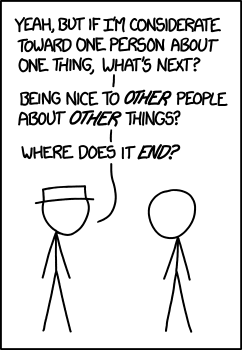
keep a transgender/transexual persons' pronouns straight
avoid using ableist language like "stupid" "lame" "dumb"
stop saying "that's so gay" when one really means "that's so stupid"
saying Happy Holidays rather than Merry Christmas (unless one knows the person you're greeting happens to be Christian and/or does not mind being wished a Merry Christmas)
change a sports team name like "Redskins" to something not racist
and so on.
In any event, I don't think I've found a better response then to such an attitude then the following XKCD cartoon. Pay particular attention to the mouseover text.
September 16, 2013
Queer Issue: Alan Turing Was a Genius Who Had a Lady Friend
I came across this article on Movie Scope today onThe Imitation Game about the life of Alan Turing, the openly gay man who cracked NAZI codes, saved thousands of lives, shortened WWII, on his way to becoming the father of computer science.
I have no idea how the movie intends to portray Turing (and frankly do not have the time to do the research) but there were a few details that jumped out at me. For starters the article points out that Kiera Knightly will play Alan Turing's "lady friend". That's nice, given that Turing was GAY, I'm sure there are plenty of ladies out there who enjoyed coordinating accessories with him. I mean, that is what gay men and ladies do together, right? Certainly, they could not just be co-workers and Knightly is simply Turing's friend (why does the term 'lady' even need to be there?) This is a movie after all, certainly the male lead is just absolutely, going to have to have fall in love with his lady friend, right?
Oh wait, Turing was GAY? But the article does not mention that at all, just that he was a victim or something of a close minded government.
I mean honestly, if someone did not know Turing was gay, they might very easily come away with impression that Turing is going to hook up with his lady friend from this article.
I have no idea how the movie intends to portray Turing (and frankly do not have the time to do the research) but there were a few details that jumped out at me. For starters the article points out that Kiera Knightly will play Alan Turing's "lady friend". That's nice, given that Turing was GAY, I'm sure there are plenty of ladies out there who enjoyed coordinating accessories with him. I mean, that is what gay men and ladies do together, right? Certainly, they could not just be co-workers and Knightly is simply Turing's friend (why does the term 'lady' even need to be there?) This is a movie after all, certainly the male lead is just absolutely, going to have to have fall in love with his lady friend, right?
Oh wait, Turing was GAY? But the article does not mention that at all, just that he was a victim or something of a close minded government.
I mean honestly, if someone did not know Turing was gay, they might very easily come away with impression that Turing is going to hook up with his lady friend from this article.
September 14, 2013
Queer Issue: Sex Evil! Violence Good!
Alright, it's no secret that violence is practically worshiped in our culture, while anything related to sex or sexuality is shunned.
However, a thousand bucks for the person who can find a more extreme example of this, than the poster I came across today while doing research for an article an transgender serial killers:
Dr. Jekyll and Sister Hyde Poster at Wikipedia
Note how "...victim after victim dies horribly in throat cutting orgy" is an unambiguous selling point, while the idea of seeing someone transform between genders is presented as a warning label.
Actually, it is still a selling point in it's own reverse psychology sort of fashion, but I should point out that the message here still revolves around the idea that changing one's physical sex is somehow shocking and grotesque, as opposed to, I dunno, a medical procedure with no more sociological significance than having one's tonsils or wisdom teeth removed.
That is, one is supposed to find the idea of changing one's sex extremely revolting and shocking, and since that is the reason for seeing most horror films, it becomes the main selling point,
I should probably also point out that this attitude was also shown during the scenes if The Christine Jorgensen Story so was certainly not uncommon during this time, although that goes without saying.
However, a thousand bucks for the person who can find a more extreme example of this, than the poster I came across today while doing research for an article an transgender serial killers:
Dr. Jekyll and Sister Hyde Poster at Wikipedia

Note how "...victim after victim dies horribly in throat cutting orgy" is an unambiguous selling point, while the idea of seeing someone transform between genders is presented as a warning label.
Actually, it is still a selling point in it's own reverse psychology sort of fashion, but I should point out that the message here still revolves around the idea that changing one's physical sex is somehow shocking and grotesque, as opposed to, I dunno, a medical procedure with no more sociological significance than having one's tonsils or wisdom teeth removed.
That is, one is supposed to find the idea of changing one's sex extremely revolting and shocking, and since that is the reason for seeing most horror films, it becomes the main selling point,
I should probably also point out that this attitude was also shown during the scenes if The Christine Jorgensen Story so was certainly not uncommon during this time, although that goes without saying.
May 8, 2013
Queer Issue: Politifacts' Rating System is a Lie (By Their Own Standards)
In an interview with CBS Face the Nation, Martina Navratilova made the claim that "In 29 states in this country you can still get fired for not just being gay, but if your employer thinks you are gay."
In response, Politifact rated the claim as being half true.
To justify their claim, Politifact points out that while 29 states do not have legislation at the state level to protect against discrimination, there are exceptions, such as those that exist for government employees, or in local municipalities that have passed anti-discrimation laws, in addition to specific employers which may also have anti-discrimination protections in place.
Politifact also points out that according to the deputy director of Lambda Legal, Hayley Gorenberg, a 1989 Supreme Court Case based around Title VII of the Civil Rights Act (Price Waterhouse vs. Hopkins) *might* have set a precedent that could bar discrimination based upon an employer believing an employee is uh... "gay" (more on the word choice in the article here later).
So Politifacts' arguments boil down to two main points. One is that exceptions exist within the 29 states that do not have legislation at the state level to offer protection against discrimination based upon sexual orientation. The second point revolves around the possibility (offered up by Gorenberg) that the Civil Rights Act might bar discrimination based upon an employer merely believing an employee is uh... "gay".
The first part of Politifact's argument holds some water. Even though Navratilove never said that "no protections exist" in 29 states, the fact that a certain number of protections do exist for certain uh... "gays" might have justified rating Navratilove's claim as "Mostly True" rather than "True".
However, the second part is complete horseshit. There has never been an actual case before a court in which an individual has successfully used the precedent set by Price Waterhouse vs. Hopkins to argue against discrimination based upon an employer's belief that an employee was/is uh... "gay". So any lawyer who argues that it might be *possible* that such protections exist is simply offering up an opinion on what *might* happen if a fired employee were to use it in a court trial.
This is but the first error that Politifact makes in their use of Price Waterhouse vs. Hopkins. In their article, Politifact states:
Let's break this down:
1) Navratilove used the term gay in her original claim, which is problematic in it's own right since it ignores transgender and transsexual identities (along with lesbian, bi, pan, etc...)
2) However, the number of states that do not offer up legislation that protect specifically against discrimination based upon gender identity is much larger than the number of states that protect based upon sexual orientation. Which means that to acknowledge gender identity would require a much wider analysis than what Politifact offers here.
3) I have seen it argued in the past that anti-discrimination laws for sex/gender might also apply to gender identity.
4) Since Price Waterhouse vs. Hopkins dealt with discrimination based upon gender stereotypes (not on sexuality) it seems like it would be the sort of test case one might use to expand protection against discrimination based upon sex/gender to discrimination based upon gender identity.
5) It is therefore possible that this is what Gorenberg was refering to when she cited Price Waterhouse vs. Hopkins as a precedent that might offer some protections to those who are uh... "gay".
6) Gorenberg, being deputy director of Lambda Legal should know the difference between sexual orientation and gender identity.
This all leads to the conclusion that Politifact, in order to apply Price Waterhouse vs. Hopkins to Navratiloves' claim, deliberately conflated sexual orientation with gender identity. I'd also like to point out the fact that while Politifact does not quote Gorenberg directly when they say "This precedent could protect a straight person who appeared to an employer to be "gay" and suffered discrimination" they do put the word "gay" in scare quotes.
In any case, this all makes Politifacts' arguments here really, really screwy. Navratilove makes a claim that applies solely to sexual orientation. In analyzing it, Politifact brings in a case that might apply to gender identity, yet continues to use the term "gay" for unknown reasons. Furthermore, Politifact makes *no* mention of the current state of anti-discrimination laws based upon gender identity, which have a completely different status from those that apply to sexual orientation.
This is a *gargantuan* omission. One which makes Politifact's use of the sin of omission against Navratilove extremely hypocritical.
However, even if they are correctly representing Gorenberg's citation of Price Waterhouse vs. Hopkins, Politifact is still relying on an expert opinion (which they have done in the past) as a key part of their ratings process. So even if they are correctly citing Gorenberg, they are still committing the logical fallacy of appeal to authority in order to justify their rating of Navratilove's claim.
In the grand scheme of things, I have no problem with Politifact or any organization wishing to present contrary opinions to publicly made claims. But in attempting to clarify the situation in this case, Politifact only managed to further muddy the waters. Combine this with their repeated use of the appeal to authority fallacy and it becomes clear that it is Politifact and their rating system which is misrepresenting the truth.
In response, Politifact rated the claim as being half true.
To justify their claim, Politifact points out that while 29 states do not have legislation at the state level to protect against discrimination, there are exceptions, such as those that exist for government employees, or in local municipalities that have passed anti-discrimation laws, in addition to specific employers which may also have anti-discrimination protections in place.
Politifact also points out that according to the deputy director of Lambda Legal, Hayley Gorenberg, a 1989 Supreme Court Case based around Title VII of the Civil Rights Act (Price Waterhouse vs. Hopkins) *might* have set a precedent that could bar discrimination based upon an employer believing an employee is uh... "gay" (more on the word choice in the article here later).
So Politifacts' arguments boil down to two main points. One is that exceptions exist within the 29 states that do not have legislation at the state level to offer protection against discrimination based upon sexual orientation. The second point revolves around the possibility (offered up by Gorenberg) that the Civil Rights Act might bar discrimination based upon an employer merely believing an employee is uh... "gay".
The first part of Politifact's argument holds some water. Even though Navratilove never said that "no protections exist" in 29 states, the fact that a certain number of protections do exist for certain uh... "gays" might have justified rating Navratilove's claim as "Mostly True" rather than "True".
However, the second part is complete horseshit. There has never been an actual case before a court in which an individual has successfully used the precedent set by Price Waterhouse vs. Hopkins to argue against discrimination based upon an employer's belief that an employee was/is uh... "gay". So any lawyer who argues that it might be *possible* that such protections exist is simply offering up an opinion on what *might* happen if a fired employee were to use it in a court trial.
This is but the first error that Politifact makes in their use of Price Waterhouse vs. Hopkins. In their article, Politifact states:
Hayley Gorenberg, deputy legal director of Lambda Legal, cited the 1989 Supreme Court case Price Waterhouse vs. Hopkins. In that case, a woman sued the accounting firm where she worked because she was not offered a promotion after a senior manager told her she should "walk more femininely, talk more femininely, dress more femininely, wear make-up, have her hair styled, and wear jewelry." The plaintiff convinced the court that sex stereotyping constitutes sex discrimination, Gorenberg said. This precedent could protect a straight person who appeared to an employer to be "gay" and suffered discrimination as a result.
Let's break this down:
1) Navratilove used the term gay in her original claim, which is problematic in it's own right since it ignores transgender and transsexual identities (along with lesbian, bi, pan, etc...)
2) However, the number of states that do not offer up legislation that protect specifically against discrimination based upon gender identity is much larger than the number of states that protect based upon sexual orientation. Which means that to acknowledge gender identity would require a much wider analysis than what Politifact offers here.
3) I have seen it argued in the past that anti-discrimination laws for sex/gender might also apply to gender identity.
4) Since Price Waterhouse vs. Hopkins dealt with discrimination based upon gender stereotypes (not on sexuality) it seems like it would be the sort of test case one might use to expand protection against discrimination based upon sex/gender to discrimination based upon gender identity.
5) It is therefore possible that this is what Gorenberg was refering to when she cited Price Waterhouse vs. Hopkins as a precedent that might offer some protections to those who are uh... "gay".
6) Gorenberg, being deputy director of Lambda Legal should know the difference between sexual orientation and gender identity.
This all leads to the conclusion that Politifact, in order to apply Price Waterhouse vs. Hopkins to Navratiloves' claim, deliberately conflated sexual orientation with gender identity. I'd also like to point out the fact that while Politifact does not quote Gorenberg directly when they say "This precedent could protect a straight person who appeared to an employer to be "gay" and suffered discrimination" they do put the word "gay" in scare quotes.
In any case, this all makes Politifacts' arguments here really, really screwy. Navratilove makes a claim that applies solely to sexual orientation. In analyzing it, Politifact brings in a case that might apply to gender identity, yet continues to use the term "gay" for unknown reasons. Furthermore, Politifact makes *no* mention of the current state of anti-discrimination laws based upon gender identity, which have a completely different status from those that apply to sexual orientation.
This is a *gargantuan* omission. One which makes Politifact's use of the sin of omission against Navratilove extremely hypocritical.
However, even if they are correctly representing Gorenberg's citation of Price Waterhouse vs. Hopkins, Politifact is still relying on an expert opinion (which they have done in the past) as a key part of their ratings process. So even if they are correctly citing Gorenberg, they are still committing the logical fallacy of appeal to authority in order to justify their rating of Navratilove's claim.
In the grand scheme of things, I have no problem with Politifact or any organization wishing to present contrary opinions to publicly made claims. But in attempting to clarify the situation in this case, Politifact only managed to further muddy the waters. Combine this with their repeated use of the appeal to authority fallacy and it becomes clear that it is Politifact and their rating system which is misrepresenting the truth.
November 19, 2012
Good News! Holy Innocents Parish Accepted into Margaretville Interfaith Council
The issue that I blogged about earlier has now been resolved and the Holy Innocents Parish has been accepted into the Margaretville Interfaith Council.
More info can be found at this article on Diversity Rules!
More info can be found at this article on Diversity Rules!
November 18, 2012
Not Everyone Should Be Asked to Be Thankful
One of Mark Twain's more interesting pieces for me is his short story War Prayer, which asks a very interesting question. When we ask for victory in war, what are really asking for? For when one thinks of ones country being victorious in war, we very rarely think of the consequences, for the lives lost, the blood shed, or the psychological wounds that are created by war.
I would like to ask with this article, a question that might seem unrelated, but I think is very much in the same vein as Twain's question. When we give thanks, what are we really giving thanks for? For example, when we give thanks for the food we have, do we think of the possible workers who may have been exploited in the name of corporate profits, so that we may have that food?
Make no mistake, I am grateful for what I have. I know my current situation, while far from ideal, could be worse.
But this is going to be the first Thanksgiving I will be celebrating following the death of my Aunt Janine from breast cancer. She had been first diagnosed shortly before I graduated college. The first instance was eventually beaten into remission. Then two years later, the cancer came back.
This was last year, several months before Thanksgiving. Not knowing the exact situation, I sent an email to her, asking if it would be okay if I were to come down to their place on Long Island to cook Thanksgiving dinner there myself.
She emailed me back informing me that the cancer was terminal. I remember wanting to send something, to make some final statement to her. I didn't want to call because I was afraid of interrupting some valuable rest time. I wanted to send an email but frequently ended up finding myself staring at a blank computer screen, unable to write anything.
It turned out that Thanksgiving was the last meal that Aunt Janine was able to eat solid food. She passed away several days later.
This past October, which happens to be Breast Cancer Awareness Month, I found myself reading about Pinksploitation and how slapping a pink ribbon on everything allows some corporations to wrack up large profits while continuing to use known carcinogens in their products.
I don't know what I should be thankful for in this situation. I just think it needs to be said that not every cloud has a silver lining. There really are certain situations that are just plain awful.
Yes, I know the dangers of overly negative thinking as well as anyone. I am very aware how giving into negative feelings can cause one to lose all hope. I know how easily despair can bring one's life to a grinding halt. Being depressed or sick sucks, but stigmatizing those who are mentally ill or otherwise unhealthy, by making them feel guilty for their feelings or telling them that there is something "wrong" with them solves nothing. I refuse to tell someone they have to feel better about their own situation and that they should therefore focus on and be grateful for those things that they do have.
I know as an exercise, that it can be useful to focus one's thinking on the good things one has to help oneself feel better. But about a month ago, I was in a situation that made me feel very, well, depressed. I found myself thinking of the things I did have and as a result, found myself becoming even more depressed over the situation. Why, when I have all these good things in my life, should I be depressed? Surely there must be something wrong with me for *being* depressed when I do have so much to be thankful for.
It was only after I came to the realization, that hey, there really is nothing wrong with me for being depressed, that I started to find myself (oddly enough) feeling better. Telling myself that I was not to blame for being sad and upset was what allowed me to feel better. It was not thinking about the good things I have which enabled me to break out of the period of depression I found myself in.
As far as LGBTQ rights go, I can say that I am somewhat grateful that as a nation we are making progress towards marriage equality. I am thankful that the state I live in (New York) has laws against employers discriminating on the basis of sexual orientation.
But I am not grateful for the fact that ENDA has not yet passed at the Federal level, nor am I happy about the fact that GENDA (legislation that would outlaw discrimination on the basis of gender identity) has languished for so long in New York State.
I am also not grateful for how the marriage equality movement has taken so much attention away from these important pieces of legislation or from other issues that so desperately need our focus.
I find it difficult to be grateful when organizations such as the Salvation Army continues to discriminate against the LGBTQ community or when organizations such as the Boy Scouts of America still send the message to our community's youth that there is something fundamentally wrong with with being queer.
I am frustrated that the struggles for civil rights of the Transgender and Transsexual communities continue to receive far too little attention and political action.
I can say that I am grateful that I have never experienced homelessness or been sexually assaulted but I refuse to give thanks to a world in which the condition of homelessness exists and in which rape culture is celebrated by the mainstream.
Ultimately, I think there is something problematic about a culture that only celebrates that which is positive and refuses to critically think about any possible shortcomings. "We ARE number one and you HAVE to be grateful for that" is not a great message to tell people who have terminal or long term debilitating illnesses, who are unemployed or living in poverty, who are marginalized, or who live in constant fear, be it from bigotry or the possibility of facing overt violence.
All I ask is that people give some real thought this year to what we are really giving thanks for.
I would like to ask with this article, a question that might seem unrelated, but I think is very much in the same vein as Twain's question. When we give thanks, what are we really giving thanks for? For example, when we give thanks for the food we have, do we think of the possible workers who may have been exploited in the name of corporate profits, so that we may have that food?
Make no mistake, I am grateful for what I have. I know my current situation, while far from ideal, could be worse.
But this is going to be the first Thanksgiving I will be celebrating following the death of my Aunt Janine from breast cancer. She had been first diagnosed shortly before I graduated college. The first instance was eventually beaten into remission. Then two years later, the cancer came back.
This was last year, several months before Thanksgiving. Not knowing the exact situation, I sent an email to her, asking if it would be okay if I were to come down to their place on Long Island to cook Thanksgiving dinner there myself.
She emailed me back informing me that the cancer was terminal. I remember wanting to send something, to make some final statement to her. I didn't want to call because I was afraid of interrupting some valuable rest time. I wanted to send an email but frequently ended up finding myself staring at a blank computer screen, unable to write anything.
It turned out that Thanksgiving was the last meal that Aunt Janine was able to eat solid food. She passed away several days later.
This past October, which happens to be Breast Cancer Awareness Month, I found myself reading about Pinksploitation and how slapping a pink ribbon on everything allows some corporations to wrack up large profits while continuing to use known carcinogens in their products.
I don't know what I should be thankful for in this situation. I just think it needs to be said that not every cloud has a silver lining. There really are certain situations that are just plain awful.
Yes, I know the dangers of overly negative thinking as well as anyone. I am very aware how giving into negative feelings can cause one to lose all hope. I know how easily despair can bring one's life to a grinding halt. Being depressed or sick sucks, but stigmatizing those who are mentally ill or otherwise unhealthy, by making them feel guilty for their feelings or telling them that there is something "wrong" with them solves nothing. I refuse to tell someone they have to feel better about their own situation and that they should therefore focus on and be grateful for those things that they do have.
I know as an exercise, that it can be useful to focus one's thinking on the good things one has to help oneself feel better. But about a month ago, I was in a situation that made me feel very, well, depressed. I found myself thinking of the things I did have and as a result, found myself becoming even more depressed over the situation. Why, when I have all these good things in my life, should I be depressed? Surely there must be something wrong with me for *being* depressed when I do have so much to be thankful for.
It was only after I came to the realization, that hey, there really is nothing wrong with me for being depressed, that I started to find myself (oddly enough) feeling better. Telling myself that I was not to blame for being sad and upset was what allowed me to feel better. It was not thinking about the good things I have which enabled me to break out of the period of depression I found myself in.
As far as LGBTQ rights go, I can say that I am somewhat grateful that as a nation we are making progress towards marriage equality. I am thankful that the state I live in (New York) has laws against employers discriminating on the basis of sexual orientation.
But I am not grateful for the fact that ENDA has not yet passed at the Federal level, nor am I happy about the fact that GENDA (legislation that would outlaw discrimination on the basis of gender identity) has languished for so long in New York State.
I am also not grateful for how the marriage equality movement has taken so much attention away from these important pieces of legislation or from other issues that so desperately need our focus.
I find it difficult to be grateful when organizations such as the Salvation Army continues to discriminate against the LGBTQ community or when organizations such as the Boy Scouts of America still send the message to our community's youth that there is something fundamentally wrong with with being queer.
I am frustrated that the struggles for civil rights of the Transgender and Transsexual communities continue to receive far too little attention and political action.
I can say that I am grateful that I have never experienced homelessness or been sexually assaulted but I refuse to give thanks to a world in which the condition of homelessness exists and in which rape culture is celebrated by the mainstream.
Ultimately, I think there is something problematic about a culture that only celebrates that which is positive and refuses to critically think about any possible shortcomings. "We ARE number one and you HAVE to be grateful for that" is not a great message to tell people who have terminal or long term debilitating illnesses, who are unemployed or living in poverty, who are marginalized, or who live in constant fear, be it from bigotry or the possibility of facing overt violence.
All I ask is that people give some real thought this year to what we are really giving thanks for.
November 12, 2012
Local Issue: Shame on Margaretville Interfaith Council!
Sharing because of the shortage of local pro-queer media:
From Diversity Rules Magazine: Shame on Margaretville Interfaith Council! by Jim Kouri
From Diversity Rules Magazine: Shame on Margaretville Interfaith Council! by Jim Kouri
The Margaretville Interfaith Council is not allowing membership to Holy Innocents Catholic Church, an Apostolic Catholic Church independent from Papal Authority, primarily because of its acceptance of queer folks and marrying them. The council is concerned that other churches will leave the council if “the gay church” is allowed to join. Holy Innocents Church does a lot of good things in the greater Margaretville area and it's a real travesty that the Interfaith Council sees fit to discriminate against this church, a fellow Christian Church helping people in need and ministering to them.
Here's a link to Holy Innocents and check out for yourself what great church they are:
http://www.holyinnocentscacina.org
If you want to help in battling discrimination in this small Delaware County village, contact Francisco J. Betancourt, Co-Pastor, at 845.586.2201. Tell him you heard about his plight from Diversity Rules Magazine and you want to know how you can help!
If you want to express your outrage directly to the Interfaith Council the contact person is, Rev. Richard Dykstra, Secretary/Treasurer. His contact information is as follows:
Rev. Richard Dykstra
PO Box 702
Margaretville, NY 12455
607.326.7101
May 18, 2012
Queer Issue: The Queer Umbrella is an Oxymoron
Having just come across this poll on The Huffington Post, I felt a bit of a need to respond. Why? Becuase it's a completely pointless question to ask.
The whole purpose of the developing a queer identity, historically speaking, was to shun labels, boundries, and umbrellas. To even say something like "queer umbrella" would be like saying "I want to blur the boundries between good and evil, but cannot accept that there are shades of grey between them". Likewise, asking if the queer identity includes polyamorous relationships and asexuals is like asking if oak trees and mammels are all catagories of nouns.
If one thinks that asexuals and polyamourous relationships might not be or cannot be included in the term queer, than one obviously knows nothing of queer history or the origins of such.
The whole purpose of the developing a queer identity, historically speaking, was to shun labels, boundries, and umbrellas. To even say something like "queer umbrella" would be like saying "I want to blur the boundries between good and evil, but cannot accept that there are shades of grey between them". Likewise, asking if the queer identity includes polyamorous relationships and asexuals is like asking if oak trees and mammels are all catagories of nouns.
If one thinks that asexuals and polyamourous relationships might not be or cannot be included in the term queer, than one obviously knows nothing of queer history or the origins of such.
May 9, 2012
Queer Issue: What is Marriage For?
With the recent announcement from President Obama, in which he endorsed marriage equality for same sex couples, the LGBTQ social networking scene just exploded with a the sort of rainbow collective joy that one might assume signalled the second coming of Christ.
However, I think this is as good a time as any to ask a question that rarely gets brought up: What purpose does state sanctioned marriage serve? That is, why should the state sanction specific types of relationships?
Consider the following possible reasons why the state might wish to sanction marriage:
Religion
In the united states, the first ammendment would appear to prevent the government from sanctioning *any* religious form of marriage whatsoever. If the state were to sanction marriage, it would have to do so with reasons that would be unrelated to religion.
Promote Sexual Monogamy
The government needs to stay the hell out of peoples' bedrooms. There is no bloody reason the state should care about the sexual activities that occur between consenting adults. Any questions?
Economics
Two (or more) people living together in the same dwelling and sharing resources, would (logically speaking) use fewer resources than if they lived separately. Therefore, it could be argued that it would benefit society on the whole, if more people lived together. Therefore, it would benefit society on the whole to promote relationships that encourage people living together.
Several problems with this. One is that it does not matter if the people involved are lovers or merely room-mates, they are still going to be using less resources regardless. The second is that, well what's the point of the government providing economic advantages to a situation that already comes with it's own economic incentives?
Parenting
We often think that marriage means a better environment to raise kids in. I mean, obviously two people in a committed to raising a child(ren) are going to have an advantage over a single parent. Furthermore, given the whole "kids are the future of society" thing, it makes sense for society to provide benefits (such as tax breaks) to individuals who are raising kids.
But since single parents need more support over parents who are in committed relationships, it makes more sense for the government to provide more benefits to single parents, not less.
Conclusion
In short, it is difficult to find a reason for the state to sanction *any* marriage. In fact, it makes more sense for the state to provide additional benefits in some cases to adults who are single (if they are raising kids) than it does providing benefits to those who are in committed relationships.
While LGB advocates celebrate Obama's endorsement, they fail to ask what exactly is the purpose of even having state sanctioned marriage. I say leave marriage to the religious communities that wish to sanction it, leave the state out of it.
Ultimately, the queer community has bigger issues to pursue, such as seeking to end discrimination on the basis of sexual orientation and gender identity, dealing with homelessness (a problem which disproportionally affects lgbtq youth), or doing something as simple as passing GENDA in NY State. Marriage equality will benefit the wealthiest of the LGBTQ community, but will do little for those who need it the most.
Is this true equality?
However, I think this is as good a time as any to ask a question that rarely gets brought up: What purpose does state sanctioned marriage serve? That is, why should the state sanction specific types of relationships?
Consider the following possible reasons why the state might wish to sanction marriage:
Religion
In the united states, the first ammendment would appear to prevent the government from sanctioning *any* religious form of marriage whatsoever. If the state were to sanction marriage, it would have to do so with reasons that would be unrelated to religion.
Promote Sexual Monogamy
The government needs to stay the hell out of peoples' bedrooms. There is no bloody reason the state should care about the sexual activities that occur between consenting adults. Any questions?
Economics
Two (or more) people living together in the same dwelling and sharing resources, would (logically speaking) use fewer resources than if they lived separately. Therefore, it could be argued that it would benefit society on the whole, if more people lived together. Therefore, it would benefit society on the whole to promote relationships that encourage people living together.
Several problems with this. One is that it does not matter if the people involved are lovers or merely room-mates, they are still going to be using less resources regardless. The second is that, well what's the point of the government providing economic advantages to a situation that already comes with it's own economic incentives?
Parenting
We often think that marriage means a better environment to raise kids in. I mean, obviously two people in a committed to raising a child(ren) are going to have an advantage over a single parent. Furthermore, given the whole "kids are the future of society" thing, it makes sense for society to provide benefits (such as tax breaks) to individuals who are raising kids.
But since single parents need more support over parents who are in committed relationships, it makes more sense for the government to provide more benefits to single parents, not less.
Conclusion
In short, it is difficult to find a reason for the state to sanction *any* marriage. In fact, it makes more sense for the state to provide additional benefits in some cases to adults who are single (if they are raising kids) than it does providing benefits to those who are in committed relationships.
While LGB advocates celebrate Obama's endorsement, they fail to ask what exactly is the purpose of even having state sanctioned marriage. I say leave marriage to the religious communities that wish to sanction it, leave the state out of it.
Ultimately, the queer community has bigger issues to pursue, such as seeking to end discrimination on the basis of sexual orientation and gender identity, dealing with homelessness (a problem which disproportionally affects lgbtq youth), or doing something as simple as passing GENDA in NY State. Marriage equality will benefit the wealthiest of the LGBTQ community, but will do little for those who need it the most.
Is this true equality?
February 1, 2012
Queer Issue: Choosing to be Queer is But an Illusion.
Sometimes, as someone who majored in philosophy in college, there comes a certain times when watching certain debates play out, feels to me like watching two boxers going at but where both participants were heavily drugged and blindfolded. This is in addition to neither ever having been properly taught how to spar in the first place.
One debate which exists within the queer community that stands out in this category above all others is the discussion on whether or not one is "born" gay. The arguments of both sides tend to break down like this.
Pro: Sexuality is not a choice, we can't choose who we're going to be attracted to. The scientific evidence all points to sexuality having a genetic component. Furthermore, if sexuality is not a choice than it would mean conclusively that queer behaviour should not be outlawed at all or discriminated against in any way.
Against: Sexuality is a choice and we should not have to justify our lifestyles by claiming that it is not a choice. Furthermore, discrimination and bigotry have not ended for those groups (people of color, women, etc.) who did not choose their minority status either.
Now let me say that both arguments have flaws. Allow me to break them down.
Pro: Moral is different from natural, a mistake many people make. I have problems with the term "unnatural" as well, anything that is "unnatural" technically can't exist (or exist only in imagination). If one desires something, then that desire is natural. Furthermore, simply because one naturally desires something, does not make it moral. If I desire to kill someone who wrongs me, killing them would still be "immoral", no matter the strength or innateness of that desire. There is also a good possibility that pedophilia itself is also an innate desire. There is good reason for paedophilia to remain illegal, no matter how natural or innate the desire to have sex with children is for some individuals.
If we reduce morality to that which we naturally desire, then anything I desire becomes moral by default. It would create total chaos. I want to kill? Fine! Steal my neighbours property? That's cool! Rape and pillage? Get your freak on! Obviously there needs to be some other criteria altogether for developing morality. I'll get to one later, but that's the gist of why mere desire does not work for justifying one's behaviour.
Against: The argument that we queers should not have to justify our existence by proving that sexuality is innate has one obvious flaw - it is a normative claim and has absolutely nothing to do with the way the world is. Technically speaking, I even agree with it. In an ideal world, people would not need to justify sexual activity based upon how natural or innate their desire, but rather on the consent of all participants. This should be the criteria, nothing else.
However, I have to point out that we do not live in an ideal world. We live in a cruel and arbitrary one. There have been cases where queers have been able to pass legislation by arguing that being gay should belong to a protected class (much like race and gender). In short, there are actual benefits to being able do demonstrate that one's sexual orientation is innate, rather then a product of free will.
Which brings me to the last and most important point to all of this. There is absolutely no reason to believe that free will exists. Granted this is hardly a decided philosophical issue but it is one that is very relevant to this discussion. In order to be able to choose to be queer, then free will would need to exist in order for it to be a genuine choice. If free will does not exist, then all choices are naught but an illusion, including the choice to be queer.
I know this is an idea that most people do not like. After all, we like to think of ourselves as autonomous beings capable of changing the world around us. This desire (which is natural for any sentient being) would of course lead to one believing in that free will exists, even when it does not.
However, I believe in determinism simply because of well, all the evidence points to us living in a world that obeys a few simple rules of physics, which implies a universe with a set future. If the future is set, then we can not affect through mere application of will, it is no more complicated than that.
Add in the mounting evidence that sexual orientation does have it's roots in our genes and it becomes increasingly difficult to see how sexual orientation is a choice. I have no strong evidence to back myself up on this, but I would hazard a guess that bi, pan, and omnisexual individuals, as well as those with a fluid sexual identity, are among those who are most likely to view sexual identity as a matter of choice.
So in summary:
-There is no rule that says a natural desire means that such behaviour is moral.
-In an ideal world we should not have to prove scientifically that we exist or that being queer is not a choice in order for queers to be accepted by society. Only the consent of all participants would matter when determining the morality of a sexual act. Too bad we don't live in an ideal world.
-Given the lack of evidence for free will, therefore it is only logical to believe that being gay is not a choice by default.
All clear? Agree or disagree? Let me know!
One debate which exists within the queer community that stands out in this category above all others is the discussion on whether or not one is "born" gay. The arguments of both sides tend to break down like this.
Pro: Sexuality is not a choice, we can't choose who we're going to be attracted to. The scientific evidence all points to sexuality having a genetic component. Furthermore, if sexuality is not a choice than it would mean conclusively that queer behaviour should not be outlawed at all or discriminated against in any way.
Against: Sexuality is a choice and we should not have to justify our lifestyles by claiming that it is not a choice. Furthermore, discrimination and bigotry have not ended for those groups (people of color, women, etc.) who did not choose their minority status either.
Now let me say that both arguments have flaws. Allow me to break them down.
Pro: Moral is different from natural, a mistake many people make. I have problems with the term "unnatural" as well, anything that is "unnatural" technically can't exist (or exist only in imagination). If one desires something, then that desire is natural. Furthermore, simply because one naturally desires something, does not make it moral. If I desire to kill someone who wrongs me, killing them would still be "immoral", no matter the strength or innateness of that desire. There is also a good possibility that pedophilia itself is also an innate desire. There is good reason for paedophilia to remain illegal, no matter how natural or innate the desire to have sex with children is for some individuals.
If we reduce morality to that which we naturally desire, then anything I desire becomes moral by default. It would create total chaos. I want to kill? Fine! Steal my neighbours property? That's cool! Rape and pillage? Get your freak on! Obviously there needs to be some other criteria altogether for developing morality. I'll get to one later, but that's the gist of why mere desire does not work for justifying one's behaviour.
Against: The argument that we queers should not have to justify our existence by proving that sexuality is innate has one obvious flaw - it is a normative claim and has absolutely nothing to do with the way the world is. Technically speaking, I even agree with it. In an ideal world, people would not need to justify sexual activity based upon how natural or innate their desire, but rather on the consent of all participants. This should be the criteria, nothing else.
However, I have to point out that we do not live in an ideal world. We live in a cruel and arbitrary one. There have been cases where queers have been able to pass legislation by arguing that being gay should belong to a protected class (much like race and gender). In short, there are actual benefits to being able do demonstrate that one's sexual orientation is innate, rather then a product of free will.
Which brings me to the last and most important point to all of this. There is absolutely no reason to believe that free will exists. Granted this is hardly a decided philosophical issue but it is one that is very relevant to this discussion. In order to be able to choose to be queer, then free will would need to exist in order for it to be a genuine choice. If free will does not exist, then all choices are naught but an illusion, including the choice to be queer.
I know this is an idea that most people do not like. After all, we like to think of ourselves as autonomous beings capable of changing the world around us. This desire (which is natural for any sentient being) would of course lead to one believing in that free will exists, even when it does not.
However, I believe in determinism simply because of well, all the evidence points to us living in a world that obeys a few simple rules of physics, which implies a universe with a set future. If the future is set, then we can not affect through mere application of will, it is no more complicated than that.
Add in the mounting evidence that sexual orientation does have it's roots in our genes and it becomes increasingly difficult to see how sexual orientation is a choice. I have no strong evidence to back myself up on this, but I would hazard a guess that bi, pan, and omnisexual individuals, as well as those with a fluid sexual identity, are among those who are most likely to view sexual identity as a matter of choice.
So in summary:
-There is no rule that says a natural desire means that such behaviour is moral.
-In an ideal world we should not have to prove scientifically that we exist or that being queer is not a choice in order for queers to be accepted by society. Only the consent of all participants would matter when determining the morality of a sexual act. Too bad we don't live in an ideal world.
-Given the lack of evidence for free will, therefore it is only logical to believe that being gay is not a choice by default.
All clear? Agree or disagree? Let me know!
January 28, 2012
Queer Issue: Some Quick Thoughts on the Academy Award Nominations...
Okay, regarding my previous post about Fincher's remake of The Girl With the Dragon Tattoo, it appears that my prediction that The Girl With the Dragon Tattoo would not win best picture, but Rooney Mara would have a shot at winning best Actress appears poised to come true. Unfortunately, The Girl With the Dragon Tattoo was not even nominated for an Oscar at all, while Rooney Mara, along with two other actors who played queer characters (Glenn Close as the crossdressing Albert Noobs, Christopher Plummer in Beginners).
Of the performances I saw, Rooney Mara certainly deserves the nomination. However, I want to point out something that's been pointed out before. Want to know the best way for an aspiring straight able bodied actor to win an Oscar? Play a queer or disabled characters. What a white actor? Well, since black face is politically incorrect, your best bet is to play a white character who helps a person with minority status who is facing discrimination and hardship to overcome that discrimination and hardship. See last years' Sandra Bullocks' win in The Blind Side for an example of this.
If Meryl Streep were to play a blind lesbian who manages to teach an inner city class (comprised mainly of poor blacks) the importance of education and thereby inspiring all of them to apply themselves so they can get into college, having nominations would be totally pointless.
Of the performances I saw, Rooney Mara certainly deserves the nomination. However, I want to point out something that's been pointed out before. Want to know the best way for an aspiring straight able bodied actor to win an Oscar? Play a queer or disabled characters. What a white actor? Well, since black face is politically incorrect, your best bet is to play a white character who helps a person with minority status who is facing discrimination and hardship to overcome that discrimination and hardship. See last years' Sandra Bullocks' win in The Blind Side for an example of this.
If Meryl Streep were to play a blind lesbian who manages to teach an inner city class (comprised mainly of poor blacks) the importance of education and thereby inspiring all of them to apply themselves so they can get into college, having nominations would be totally pointless.
December 29, 2011
Queer Issue: Will Fincher's remake of The Girl With the Dragon Tattoo make Oscar History?
Usually, I have very little interest in the Oscars. Very rarely do films or directors that I like actually win and my general impression is that Hollywood politics, rather than cinematic quality, is the primary driving force behind who the oscar goes to. There is also the issue of the allegedly liberal Hollywood - which if certain groups are to be believed, is one of the primary forcers of The Homoesexual Agenda down everyone's throats - almost never allowing films with genuine queer content to win.
Given the subjectivity of art, one can certainly debate the very notion of placing the label "Best Picture of the Year" on any film. What qualities make a movie "the best" picture anyways? Then there is the issue of the cultural significance of the Academy Awards themselves for there exists a long and storied history of the Academy choosing "Best Picture" films that lacked, shall we say, staying power.
For example consider the story of Citizen Kane being booed at the Academy Awards thanks to William Hearst's campaign against the film, while How Green Was My Valley was the film that came out on top. After that, the reputation of Citizen Kane only increased over the years, eventually being given the #1 position on the AFI's list of the Top 100 Films. There are of course other examples that cast doubt on the Academy's ability to pick out the "Best Film", Do the Right Thing losing to Driving Miss Daisy, Taxi Driver being passed over for Rocky, Shakespeare in Love winning over Saving Private Ryan. I could go on but these are generally considered as cases where the Academy picked "safe" pictures over more daring films that had greater cultural influence.
In any case, this year I might actually be paying a small amount of attention. Why? Because there are faint whispers that Fincher's remake of The Girl With the Dragon Tattoo has a shot at Oscar glory. What makes Fincher's remake interesting (to me at least) is that it belongs to the rather elite class of films that queered up their content, rather then straightened it out.
In the original Sweedish version of The Girl With the Dragon Tattoo Lisbeth Salander was shown in one brief scene, waking up naked next to another woman. In Fincher's remake, Lisbeth Salander is also shown actively seeking this female partner in a nightclub, plus we get a girl on girl kiss before she departs.
I admit that this is not a lot, but it is significant given that Lisbeth Salander is also the rare film heroine who gets to save the straight male hero, not once but twice. Not only that but he never gets the opportunity to repay her the favor. In the one situation where that she required saving, she does the all the work herself before she even meets her male co-star.
Too often when Hollywood adapts material featuring bisexual characters - or any queer content for that matter - what happens is what I call "straightening out". Same sex lovers turn into friends, overt romance becomes subtext, or in the case of The Lost Weekend guilt over a same sex encounter turns into dealing with alcoholism. The topic of Hollywood's insistence upon straightening out queer characters as, well as queer historical figures, is one I have addressed before and unfortunately, one that I will probably have to again.
Furthermore, films with genuine queer characters almost never win, while movies with straightened out characters have frequently taken home Oscar gold. For example, Shakespeare in Love and the aforementioned The Lost Weekend both straightened out bisexual individuals and were able to win the big prize. One could also make a case for A Beautiful Mind except John Nash, in spite of certain evidence to the contrary, has denied being bisexual. Also worth bringing up is the transphobic The Silence of the Lambs winning the "Best Picture" statue as well.
While films with queer characters do often get nominated, they almost never win. For example, movies such as The Kids Are All Right, The Crying Game, Brokeback Mountain, Capote, Cabaret,The Hours, The Full Monty, and Kiss of the Spider Woman have all been nominated but none of them were able to take home the statue. American Beauty is probably the most recent queer friendly film to win, but Wings - the first "Best Picture" winner (back when the honour was referred to as "Outstanding Picture") - was also the first picture to feature a full man on man kiss.
However, if The Girl With the Dragon Tattoo wins, it will be the first motion picture with a genuine and openly queer protagonist to do so. One could make a case for Lawrence of Arabia but as I understand it, that was pretty much subtext. No other film, to my knowledge has featured a genuine lgbtq character in a lead role and still pulled off an Oscar win.
Of course, the chances of The Girl With the Dragon Tattoo actually winning best picture could charitably be classified as comprable to the proverbial snowball in hell. If history is anything to go by, Mara Rooney at least stands a much better chance at winning best actress, as the Academy has never been shy about giving out top honours for portrayals of lgbtq characters. However, even if Fincher's film does not take home a statue, it is still a significant film in terms of queer content. No matter what, my fingers shall be crossed.
Given the subjectivity of art, one can certainly debate the very notion of placing the label "Best Picture of the Year" on any film. What qualities make a movie "the best" picture anyways? Then there is the issue of the cultural significance of the Academy Awards themselves for there exists a long and storied history of the Academy choosing "Best Picture" films that lacked, shall we say, staying power.
For example consider the story of Citizen Kane being booed at the Academy Awards thanks to William Hearst's campaign against the film, while How Green Was My Valley was the film that came out on top. After that, the reputation of Citizen Kane only increased over the years, eventually being given the #1 position on the AFI's list of the Top 100 Films. There are of course other examples that cast doubt on the Academy's ability to pick out the "Best Film", Do the Right Thing losing to Driving Miss Daisy, Taxi Driver being passed over for Rocky, Shakespeare in Love winning over Saving Private Ryan. I could go on but these are generally considered as cases where the Academy picked "safe" pictures over more daring films that had greater cultural influence.
In any case, this year I might actually be paying a small amount of attention. Why? Because there are faint whispers that Fincher's remake of The Girl With the Dragon Tattoo has a shot at Oscar glory. What makes Fincher's remake interesting (to me at least) is that it belongs to the rather elite class of films that queered up their content, rather then straightened it out.
In the original Sweedish version of The Girl With the Dragon Tattoo Lisbeth Salander was shown in one brief scene, waking up naked next to another woman. In Fincher's remake, Lisbeth Salander is also shown actively seeking this female partner in a nightclub, plus we get a girl on girl kiss before she departs.
I admit that this is not a lot, but it is significant given that Lisbeth Salander is also the rare film heroine who gets to save the straight male hero, not once but twice. Not only that but he never gets the opportunity to repay her the favor. In the one situation where that she required saving, she does the all the work herself before she even meets her male co-star.
Too often when Hollywood adapts material featuring bisexual characters - or any queer content for that matter - what happens is what I call "straightening out". Same sex lovers turn into friends, overt romance becomes subtext, or in the case of The Lost Weekend guilt over a same sex encounter turns into dealing with alcoholism. The topic of Hollywood's insistence upon straightening out queer characters as, well as queer historical figures, is one I have addressed before and unfortunately, one that I will probably have to again.
Furthermore, films with genuine queer characters almost never win, while movies with straightened out characters have frequently taken home Oscar gold. For example, Shakespeare in Love and the aforementioned The Lost Weekend both straightened out bisexual individuals and were able to win the big prize. One could also make a case for A Beautiful Mind except John Nash, in spite of certain evidence to the contrary, has denied being bisexual. Also worth bringing up is the transphobic The Silence of the Lambs winning the "Best Picture" statue as well.
While films with queer characters do often get nominated, they almost never win. For example, movies such as The Kids Are All Right, The Crying Game, Brokeback Mountain, Capote, Cabaret,The Hours, The Full Monty, and Kiss of the Spider Woman have all been nominated but none of them were able to take home the statue. American Beauty is probably the most recent queer friendly film to win, but Wings - the first "Best Picture" winner (back when the honour was referred to as "Outstanding Picture") - was also the first picture to feature a full man on man kiss.
However, if The Girl With the Dragon Tattoo wins, it will be the first motion picture with a genuine and openly queer protagonist to do so. One could make a case for Lawrence of Arabia but as I understand it, that was pretty much subtext. No other film, to my knowledge has featured a genuine lgbtq character in a lead role and still pulled off an Oscar win.
Of course, the chances of The Girl With the Dragon Tattoo actually winning best picture could charitably be classified as comprable to the proverbial snowball in hell. If history is anything to go by, Mara Rooney at least stands a much better chance at winning best actress, as the Academy has never been shy about giving out top honours for portrayals of lgbtq characters. However, even if Fincher's film does not take home a statue, it is still a significant film in terms of queer content. No matter what, my fingers shall be crossed.
November 27, 2011
Queer Issue: When Good Charities/Organizations Go Bad.
It's that time of year again and probably most people reading this have heard the ringing of bells for the Salvation Army. Most people probably even dropped in their lose change or maybe some dollar bills.
What many people who are donating might not realize is that the Salvation Army has a long and sordid history of discriminating against homeless and disenfranchised queer individuals as well as actively pushing for anti-queer legislation, a history that can be read about here. PFLAG of Genesee County and other organizations have engaged in boycotts of the Salvation Army because of their discriminatory policies.
The thing is, the Salvation Army is not the only charity/organization that does good deeds while otherwise promoting bigotry. Catholic Charities for example, has been in the news recently for discriminating against same sex couples and unmarried couples in their adoption programs. Much like the Salvation Army, this is an addition to promoting homophobic policies within their organization.
See also:
- Illinois, Catholic Agencies At Odds Over Gay Adoptions
- Illinois’ Catholic Charities Lose Right To Discriminate Against Same-Sex Couples
- Catholic Charities chooses worst option for complying with DC law...and pretends it has no choice
- Same-sex marriage leads Catholic Charities to adjust benefits
Another homophobic organization is the Boy Scouts of America and their bigoted Don't Ask, Don't Tell policy regarding sexual orientation. I can recall when I was in the BSA collecting food for a local food pantry and participating in a high-way cleanup where we picked up liter on a section of I-88.
Yet the BSA's DADT policy is one that is very harmful for queer youth. During my senior year of high-school, while working on my Eagle Project to achieve the highest rank that the BSA offered, I attempted suicide. My reasons had everything to do with having been forced into the closet as a result of the BSA's homophobic policy.
Now I can already hear the protests of but these organizations do good things! they feed the homeless! they provide structure and activities for youth! they rescue kittens and puppies from burning buildings! and so on...
Yes... true. But any organization that discriminates against a particular group is reinforcing bigotry and the long term effects of bigotry pretty much always include increased poverty, homelessness, suicide, delinquency, and more for the individuals against whom that bigotry is directed. In other words, charities that actively discriminate against minorities are not merely denying services to those minorities, they are contributing to a broken culture that helped to create the problem in the first place. Furthermore, any support of these organizations by outside individuals does exactly the same.
In the long run, it is better to give to and support organizations that do not practice discrimination as these organizations will have a much better effect at actually solving "the problem" (whatever "the problem" may be).
Here are a few examples worth drawing attention to:
Goodwill
Doctors Without Borders
American Red Cross
Ruth Ellis Center
Sylvia Rivera Law Project
Local Organizations for Oneonta/New York State:
- Berkshire Farm Center and Services for Youth and their LIFE House Program Oneonta
(runaway and homeless youth, foster care/adoption, various other youth related services)
- Habitat For Humanity Otsego County
(Housing)
- Oneonta Community Health Center
(Free Health Services for the Uninsured)
- Positive Connections: An HIV/AIDS support network in Upstate New York.
What many people who are donating might not realize is that the Salvation Army has a long and sordid history of discriminating against homeless and disenfranchised queer individuals as well as actively pushing for anti-queer legislation, a history that can be read about here. PFLAG of Genesee County and other organizations have engaged in boycotts of the Salvation Army because of their discriminatory policies.
The thing is, the Salvation Army is not the only charity/organization that does good deeds while otherwise promoting bigotry. Catholic Charities for example, has been in the news recently for discriminating against same sex couples and unmarried couples in their adoption programs. Much like the Salvation Army, this is an addition to promoting homophobic policies within their organization.
See also:
- Illinois, Catholic Agencies At Odds Over Gay Adoptions
- Illinois’ Catholic Charities Lose Right To Discriminate Against Same-Sex Couples
- Catholic Charities chooses worst option for complying with DC law...and pretends it has no choice
- Same-sex marriage leads Catholic Charities to adjust benefits
Another homophobic organization is the Boy Scouts of America and their bigoted Don't Ask, Don't Tell policy regarding sexual orientation. I can recall when I was in the BSA collecting food for a local food pantry and participating in a high-way cleanup where we picked up liter on a section of I-88.
Yet the BSA's DADT policy is one that is very harmful for queer youth. During my senior year of high-school, while working on my Eagle Project to achieve the highest rank that the BSA offered, I attempted suicide. My reasons had everything to do with having been forced into the closet as a result of the BSA's homophobic policy.
Now I can already hear the protests of but these organizations do good things! they feed the homeless! they provide structure and activities for youth! they rescue kittens and puppies from burning buildings! and so on...
Yes... true. But any organization that discriminates against a particular group is reinforcing bigotry and the long term effects of bigotry pretty much always include increased poverty, homelessness, suicide, delinquency, and more for the individuals against whom that bigotry is directed. In other words, charities that actively discriminate against minorities are not merely denying services to those minorities, they are contributing to a broken culture that helped to create the problem in the first place. Furthermore, any support of these organizations by outside individuals does exactly the same.
In the long run, it is better to give to and support organizations that do not practice discrimination as these organizations will have a much better effect at actually solving "the problem" (whatever "the problem" may be).
Here are a few examples worth drawing attention to:
Goodwill
Doctors Without Borders
American Red Cross
Ruth Ellis Center
Sylvia Rivera Law Project
Local Organizations for Oneonta/New York State:
- Berkshire Farm Center and Services for Youth and their LIFE House Program Oneonta
(runaway and homeless youth, foster care/adoption, various other youth related services)
- Habitat For Humanity Otsego County
(Housing)
- Oneonta Community Health Center
(Free Health Services for the Uninsured)
- Positive Connections: An HIV/AIDS support network in Upstate New York.
September 22, 2011
Queer Issue: The Girl With the Dragon Tattoo to be "gayed up"
After all the moping I've had to do recently about Hollywood's unholy obsession with straightening out originally queer characters and historical figures, I'm glad to have some good news to report. It appears that David Fincher's remake of The Girl With the Dragon Tattoo will be retaining heroine Lisbeth Salander's bisexuality. Yes! Not only that, but the 3 1/2 minute trailer features more girl on girl action than was in the original movie.
To be fair, I'm not sure how much or how explicit the same sex activity was in Stieg Larsson's original novel, as I never read it, so I can not say that Fincher's version will be queerer than Larsson's. The gaying up I'm referring to of course just with regards to the first movie that was directed by Niels Arden Oplev.
In any case, feel free to enjoy the trailer.
To be fair, I'm not sure how much or how explicit the same sex activity was in Stieg Larsson's original novel, as I never read it, so I can not say that Fincher's version will be queerer than Larsson's. The gaying up I'm referring to of course just with regards to the first movie that was directed by Niels Arden Oplev.
In any case, feel free to enjoy the trailer.
September 12, 2011
Queer Issue: Hey Hollywood! Where are the Queer Youth?
I recently came across this excellent article I am Not a Secondary Character: Queer Kids in YA, and Why We Need to Do Better at Muse Rising, and found myself thinking, what about films? Where are the stories of queer youth in cinema? I found myself looking back over the 90+ films I had reviewed here in order to figure out how many of them featured queer youth. Let me warn my readers ahead of time, the results are not going to be pretty.
Basically, I found 6 films I had reviewed that had queer youth characters. They are: Another Gay Movie, But I'm a Cheerleader, Die, Mommie, Die!, Easy A, I Now Pronounce You Chuck and Larry, and lastly, 50 Ways of Saying Fabulous, which I saw but never wrote a review of.
Really? Out of those, Another Gay Movie is just awful, But I'm a Cheerleader and 50 Ways of Saying Fabulous could hold competitions for "Most Mediocre Film Of All", and I Now Pronounce You Chuck and Larry is borderline homophobic. Only Die, Mommie, Die! and Easy A are any good. Of those last two though, the gay youth character is secondary.
But, I told myself, can that be all? Seriously? Is that it? After all the screaming by Right Wing Evangelicals about the Evils of Hollywood and their Homosexual Agenda to use radical films to recruit our youth into making America A Gay Commie Hell, I can only find 6 films that feature queer youth characters? Hollywood, really, you're not keeping up with your yearly quota! Remember the plan!
In any case, I did some searching through Netflix and the index page for Gay Celluloid and came up with the following titles as being described or appearing to have queer youth characters:
Wild Reeds
Summer Storm
Another Gay Sequel
Bowser Makes a Movie
D.E.B.S
Boy Crush
The Incredibly True Adventures of 2 Girls in Love
Ma Vie En Rose
Beautiful Thing
Europa Europa
Saved!
You Are Not Alone
Whole New Thing
Twist
My Summer of Love
Billy Elliot
Wild Tigers I Have Known
The Curiosity of Chance
You'll Get Over It
Ma Vraie Vie à Rouen
Glue
So that makes 21 titles. Now together with the previous 6 that's a grand total of 27, which is still pathetic. Several of these are notable or I've at least heard good things about them, such as Europa Europa, My Summer of Love, Billy Elliot, and Ma Vie En Rose. But in any case, how many queer youth will have even heard of these movies or have access to them?
I mean seriously, Hollywood, you are way behind schedule.
Apparently, if you are a Hollywood, you are a well adjusted adult or never bother figuring out your sexual orientation until you are in college or middle aged. Which is sad, as we owe our queer youth better than that.
I am somewhat at a loss to explain this phenomenon. I can point fingers at the now defunct Hays Code and the hypocritical ways that the MPAA rates queer movies with much harsher standards but I think goes a little bit deeper than that. For all those who claim that that Hollywood is some sort of pusher of liberal propaganda, I think the evidence often goes the other way. In this instance, it is the almost complete lack of queer youth characters on film.
Let's be frank, all companies that make movies exist to make money. It does not matter if it is an independent company or one of the big mainstream conglomerates, they only exist for the purpose of making a profit. However, I do not see ticket sales being an issue here. Why? Because Hollywood markets and makes most of it's movies off of teens, who all things considered, are probably much less likely to shun a movie with queer content. Furthermore, if studios are worried about offending homophobic groups so much, I would like to point out that the resulting controversy and protests are probably more likely to boost ticket sales, than to drive people away. In fact, I would bet that the more authority figures that will tell a teenager not to see a movie or film, the more likely that teen will go the extra mile to seek them out. It's also worth noting the success of crap like the The Da Vinci Code, which was was widely protested by the Catholic League when it was released? (Although to be fair, I never saw it after having read the god awful Dan Brown novel it was based upon).
Nope, what I think are the driving force behind this glaring absence is simply cowardice. There is no reason, financial or otherwise, that should cause producers to shy away from
There is another matter that makes this even more distressing. In the past year, the issue of suicide among queer youth has been brought to the national spotlight. While I would not argue that the lack of queer youth characters on film or in books is the driving force behind the disproportionaly high suicide rate among LGBTQIA youth, I cannot imagine that it helps. In fact, a lack of general media portrayals will only help to further the impression that being GLBTQIA is abnormal and therefore heighten feelings of isolation amongst queer youth. This in turn, can only worsen an already serious problem. What makes this situation further depressing is that is only likely to get worse. The tepid trickle that exists now will probably come to a complete stop as the last gasps of independent cinema, which has been slowly strangled over the past decade, are breathed.
Basically, I found 6 films I had reviewed that had queer youth characters. They are: Another Gay Movie, But I'm a Cheerleader, Die, Mommie, Die!, Easy A, I Now Pronounce You Chuck and Larry, and lastly, 50 Ways of Saying Fabulous, which I saw but never wrote a review of.
Really? Out of those, Another Gay Movie is just awful, But I'm a Cheerleader and 50 Ways of Saying Fabulous could hold competitions for "Most Mediocre Film Of All", and I Now Pronounce You Chuck and Larry is borderline homophobic. Only Die, Mommie, Die! and Easy A are any good. Of those last two though, the gay youth character is secondary.
But, I told myself, can that be all? Seriously? Is that it? After all the screaming by Right Wing Evangelicals about the Evils of Hollywood and their Homosexual Agenda to use radical films to recruit our youth into making America A Gay Commie Hell, I can only find 6 films that feature queer youth characters? Hollywood, really, you're not keeping up with your yearly quota! Remember the plan!
In any case, I did some searching through Netflix and the index page for Gay Celluloid and came up with the following titles as being described or appearing to have queer youth characters:
Wild Reeds
Summer Storm
Another Gay Sequel
Bowser Makes a Movie
D.E.B.S
Boy Crush
The Incredibly True Adventures of 2 Girls in Love
Ma Vie En Rose
Beautiful Thing
Europa Europa
Saved!
You Are Not Alone
Whole New Thing
Twist
My Summer of Love
Billy Elliot
Wild Tigers I Have Known
The Curiosity of Chance
You'll Get Over It
Ma Vraie Vie à Rouen
Glue
So that makes 21 titles. Now together with the previous 6 that's a grand total of 27, which is still pathetic. Several of these are notable or I've at least heard good things about them, such as Europa Europa, My Summer of Love, Billy Elliot, and Ma Vie En Rose. But in any case, how many queer youth will have even heard of these movies or have access to them?
I mean seriously, Hollywood, you are way behind schedule.
Apparently, if you are a Hollywood, you are a well adjusted adult or never bother figuring out your sexual orientation until you are in college or middle aged. Which is sad, as we owe our queer youth better than that.
I am somewhat at a loss to explain this phenomenon. I can point fingers at the now defunct Hays Code and the hypocritical ways that the MPAA rates queer movies with much harsher standards but I think goes a little bit deeper than that. For all those who claim that that Hollywood is some sort of pusher of liberal propaganda, I think the evidence often goes the other way. In this instance, it is the almost complete lack of queer youth characters on film.
Let's be frank, all companies that make movies exist to make money. It does not matter if it is an independent company or one of the big mainstream conglomerates, they only exist for the purpose of making a profit. However, I do not see ticket sales being an issue here. Why? Because Hollywood markets and makes most of it's movies off of teens, who all things considered, are probably much less likely to shun a movie with queer content. Furthermore, if studios are worried about offending homophobic groups so much, I would like to point out that the resulting controversy and protests are probably more likely to boost ticket sales, than to drive people away. In fact, I would bet that the more authority figures that will tell a teenager not to see a movie or film, the more likely that teen will go the extra mile to seek them out. It's also worth noting the success of crap like the The Da Vinci Code, which was was widely protested by the Catholic League when it was released? (Although to be fair, I never saw it after having read the god awful Dan Brown novel it was based upon).
Nope, what I think are the driving force behind this glaring absence is simply cowardice. There is no reason, financial or otherwise, that should cause producers to shy away from
There is another matter that makes this even more distressing. In the past year, the issue of suicide among queer youth has been brought to the national spotlight. While I would not argue that the lack of queer youth characters on film or in books is the driving force behind the disproportionaly high suicide rate among LGBTQIA youth, I cannot imagine that it helps. In fact, a lack of general media portrayals will only help to further the impression that being GLBTQIA is abnormal and therefore heighten feelings of isolation amongst queer youth. This in turn, can only worsen an already serious problem. What makes this situation further depressing is that is only likely to get worse. The tepid trickle that exists now will probably come to a complete stop as the last gasps of independent cinema, which has been slowly strangled over the past decade, are breathed.
July 28, 2011
Queer Issue: Bullying and Teen Suicide
This is a little more politically focused, with it's discussions of Michele Bachman's influence on the school policies, then something I would normally promote or focus on here. But I thought this was pretty informative and wanted to make sure it was more widely seen.
July 20, 2011
Queer Issue: Marriage, Traditional and Otherwise.
At the time of this writing, New York State has passed a Marriage Equality bill allowing same sex couples to get married. This obviously has caused a great deal of celebrating among Gay and Lesbian couples who can now get married.
I have to point out that as long as government is in the business of recognizing marriages, as opposed to civil unions, there is a problem. By allowing same sex couples to get married, the State of New York has simply expanded the boundaries of discrimination, nothing more.
First off, Marriage is a religious institution and therefore the government should not be involved in getting to define what constitutes a marriage. Furthermore, outside of specific cases involving minors (death of parents, child abuse, etc.), the government has little business in deciding who can legally be a family and those who cannot be a family.
What the government should recognize are civil unions. As I have mentioned before, this should not have to have any other restrictions then what are usually placed upon any other type of contract. Adults can engage in contracts, but not minors, nor will civil unions lead to people marrying their horses, pets, and assorted potted plants.
Of course, there are some specific situations that I would like to address further.
Polygamy
Well, that actually happens to be a rather traditional way of getting hitched. There is nothing more ironic than a defender of "traditional" marriage citing same-sex marriage as a slippery slope towards that evil institution of *gasp* polygamous relationships.
I admit that I have had my prejudices in the past. I was not as open minded as I am now about open relationships. However, I have since questioned that position and believe that as long as stringent safe sex practices are observed, there is no reason why any committed relationship has to be limited to two people. Philosophically speaking it is difficult to raise ethical objections against consensual relationships among adults, even those that involve more then one person. Why should the government not recognize them as well?
Incest
There is a legitimate scientific concern that people who are closely related by genetic lineage should not procreate as the offspring are much more likely to inherit a genetic disorder. However, those who argue that marriage equality will more likely to lead to incest should be advised that more states right now allow cousins to get married then same sex partners in committed relationships. Just saying.
Furthermore, if we do not give specific special privileges, like tax breaks for adults in committed relationships, unlike to families with kids or other dependants who actually need it, there would be no reason for people who are already related to legally marry. The purpose of civil unions should be to legally expand ones family, not strengthen already existing bonds.
Conclusion
As I have written earlier, civil unions should be for specific cases, to allow partners hospital visitation and the ability to make medical decisions when one partner is unable to do so and for cases involving child custody and inheritance when one partner dies. Ultimately, what is most important is that we have the tools to define who our families are, not have to face unreasonable legal restrictions limiting our options in that regard.
I have to point out that as long as government is in the business of recognizing marriages, as opposed to civil unions, there is a problem. By allowing same sex couples to get married, the State of New York has simply expanded the boundaries of discrimination, nothing more.
First off, Marriage is a religious institution and therefore the government should not be involved in getting to define what constitutes a marriage. Furthermore, outside of specific cases involving minors (death of parents, child abuse, etc.), the government has little business in deciding who can legally be a family and those who cannot be a family.
What the government should recognize are civil unions. As I have mentioned before, this should not have to have any other restrictions then what are usually placed upon any other type of contract. Adults can engage in contracts, but not minors, nor will civil unions lead to people marrying their horses, pets, and assorted potted plants.
Of course, there are some specific situations that I would like to address further.
Polygamy
Well, that actually happens to be a rather traditional way of getting hitched. There is nothing more ironic than a defender of "traditional" marriage citing same-sex marriage as a slippery slope towards that evil institution of *gasp* polygamous relationships.
I admit that I have had my prejudices in the past. I was not as open minded as I am now about open relationships. However, I have since questioned that position and believe that as long as stringent safe sex practices are observed, there is no reason why any committed relationship has to be limited to two people. Philosophically speaking it is difficult to raise ethical objections against consensual relationships among adults, even those that involve more then one person. Why should the government not recognize them as well?
Incest
There is a legitimate scientific concern that people who are closely related by genetic lineage should not procreate as the offspring are much more likely to inherit a genetic disorder. However, those who argue that marriage equality will more likely to lead to incest should be advised that more states right now allow cousins to get married then same sex partners in committed relationships. Just saying.
Furthermore, if we do not give specific special privileges, like tax breaks for adults in committed relationships, unlike to families with kids or other dependants who actually need it, there would be no reason for people who are already related to legally marry. The purpose of civil unions should be to legally expand ones family, not strengthen already existing bonds.
Conclusion
As I have written earlier, civil unions should be for specific cases, to allow partners hospital visitation and the ability to make medical decisions when one partner is unable to do so and for cases involving child custody and inheritance when one partner dies. Ultimately, what is most important is that we have the tools to define who our families are, not have to face unreasonable legal restrictions limiting our options in that regard.
Subscribe to:
Posts (Atom)