Dallas Buyers Club
Director: Jean-Marc Vallée
Writers: Craig Borten and Melisa Wallack
Cast: Matthew McConaughey, Jennifer Garner, Jared Leto, Denis O'Hare, Steve Zahn, Michael O'Neill, Dallas Roberts, Griffin Dunne
Overview
A potent story about the development of underground drug markets in the face of the devastating HIV/AIDS crisis is undermined by Hollywood's propensity to straighten out LGBTQ heroes and the unfortunate casting of the talented (yes) but otherwise cisgendered actor Jared Leto in the role of a transgender character.
Synopsis
When Ron Woodroof (Mathew McConaughey) is diagnosed as being in the advanced stages of AIDS, he is given 30 days to live by the doctors treating him. Unwilling to accept this prognosis, he begins doing research on his own into the disease and starts taking off-market drugs that had yet to be approved by the FDA. Eventually, after a few complications and with the help of Rayon (Jared Leto) (a transgender woman who is also living with HIV that he meets during one of his hospital visits) Ron forms the Dallas Buyers Club, a program to distribute unapproved drugs that offer promise and hope to those with HIV. While this program is able to help some, it is not long before Ron and Rayon find themselves facing down increasing opposition from the authorities who want to shut down the whole operation.
The Queering
The story of the HIV epidemic is among the most horrifying stories in LGBTQ history. When the first HIV cases were discovered, the disease was deadly and before advanced anti-viral therapies were developed, the prospects of those infected were dark. In the absence of a cure and with so little known about the disease, terror and uncertainty were the characteristics of the day. It was the sort of time that tends to bring out the best and worst in people.
Unfortunately, only glimpses of the real life HIV/AIDS story make it to the big screen. While the essentials behind the actual Dallas Buyers Club formed by Ron Woodroof are approximately accurate, there are few rather problematic changes worth noting. For starters, several people close to the real Ron Woodroof have reported that he was bisexual and not at all bigoted, as depicted in the film. The other issue is that Rayon is made up. While this is not a problem in of itself, the character essentially fills the same role as a "Magic Negro" in that she helps Ron Woodroof to become a better person before winding up dead. This trope, for whatever reason, appears to becoming more often applied to LGBTQ characters, who like the "Magic Negro" serve as inspiration for the heterosexuals before typically winding up dead. Another recent example would be Tom Wilkinson's character in The Best Exotic Marigold Hotel, as well as V for Vendetta which has two examples of LGBTQ characters who serve as inspiration for the main characters before going to the great beyond. Easy A provides a non-deadly example.
In other words, we have a story of a straigt(ened out) dude saving queers with the aid of a magic queer. In the Hollywood imagination, the only true hero allowed is the cis-gendered hetero. Ron is presented as straight and macho as they come. We see him fucking a woman in the opening scene and later on engaging in bull riding. There are few moments in fact, where we are not in some way reminded that Ron is a total hetero. Just for the record and at the risk of repeating myself, I wouldn't mind this so much if it wasn't for the fact that Ron Woodroof was (probably) bisexual.
Then there is the casting of Jared Leto, a cisgendered man, in the role of a transgender woman. There are potential problems with the character, given that while the filmmakers attempt to essay a sympathetic presentation, she still tends to come across as pathetic and weak. While I think it's problematic to ignore the suffering LGBTQ people went through at the height of the AIDS crisis, I find it even more problematic to have a weaker queer character contrasted in such a fashion as is done in this film with a stronger straight(ened out) hetero male. It just doesn't jive. And that's before we get into the problems with the casting of Jared Leto. Generally speaking, acting is about taking on the role of a person not yourself. Therefore, hypothetically speaking, in a world where transgender actors were cast to play cis-gendered roles, there would be no problem with the casting of cis-gendered actors to play transgender roles. The thing is, we don't live in such a world and thus the casting comes across as a blatant form of discrimination at best, if not explicitly transphobic.
On the plus column, the film is actually more than competently made, with the some effective examples of editing being employed to demonstrate Ron's mental functions breaking down as the disease ravages his body. There are also some memorable and evocative scenes, such as one involving Ron walking through an atrium full of butterflies that land on his body. Matthew McConaughey, Jared Leto, and Jennifer Garner all give strong performances (at least insofar as their roles were written). There are also some interesting philosophical questions raised about the ethics surrounding drug testing when dealing with a disease as fatal as AIDS. How long do you let people die while tests are conducted to ensure the safety of a medication? Is it right to give people sugar pills (while tricking them into thinking they are taking the real thing) simply so researchers can isolate the placebo effect? And as I hinted at earlier, there are certain hints and shadows of the real AIDS/HIV crisis that do make it on screen, such as the scenes which show the fears and anxieties which characterized the era as well as, the extreme desperation of those people who had been infected with the virus in the early days of the epidemic.
At the end of the day though, none of these elements are enough to overcome the ahistorical straightening out that was applied to the story, nor the problematic casting of Jared Leto.
Recommendation
Not worth driving out to Dallas or joining any buyers clubs in order to see, unless one is desperately interested in seeing every film ever made with an LGBTQ character in it.
The Rating
2 out of 4 stars
Trailer
Want to find a review of a particular work? Check out the Title Index, the archive of all reviews posted listed alphabetically.
March 13, 2014


March 3, 2014
Some thoughts on the 2014 Oscars.
This may come as a surprise, but even though I consider myself a dedicated movie buff, I do not actually pay that close attention to the Oscars. Many like to call the Oscars "the Superbowl" for movie buffs. However, I pay more attention to the actual Superbowl, then I do the Oscars, in the sense that I actually sit down and watch the Superbowl each year (even though I never actually watch a football game the rest of the year), whereas I have never watched the Oscars telecast. Never ever. I understand there's a red carpet involved and people walk on it, and such and that statues get involved at some point.
Also, given how busy I was this past year, I have not actually seen any of the nominees for best picture. I was able to catch a few movies on the big screen Star Trek: Into Darkness, The Lone Ranger, and one or two others whose titles escape me. I have recently purchased copes of and plan on watching Dallas Buyers Club, Blue is the Warmest Color, and pre-ordered Philomena so expect reviews of those in the coming weeks.
However, a quick glance at the Oscar winners raised a few eyebrows for me. 12 Years a Slave winning best picture was not a surprise. Steve McQueens' Hunger fell into the ambitious but flawed category and in the end, he showed enough promise to make me very interested in whatever films he made afterwards. I do have questions about Shame as I question the concept of sex addiction itself, but I have to reserve any judgement until if and when I manage to see it.
The more problematic win was for Jared Leto's performance. I have not seen it so I cannot comment on the performance itself, but I will say that it is high time that producers started casting transgender performers in transgender roles. I won't say that doing so is the equivalent to blackface (the LGBTQ community does a little too much appropriation of the Black Civil Rights Movement as it stands) but gosh darn it, if there aren't too many parallels between the two, to let the practice go without comment.
Seriously it's high time Hollywood started casting roles appropriately. In spite of the Academy's longtime habit of rewarding them, the world does not need another able bodied, cis-gendered, white male playing a disabled person, a transgender/transexual person, or a person of color.
February 20, 2014
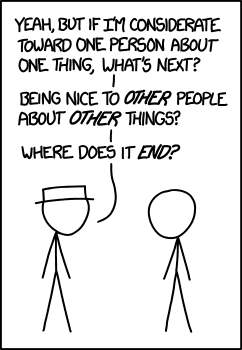
I really dig this XKCD cartoon.
There is this certain tendency I think, when social justice issues are brought up for certain people to react with "But but it's so hard to [blank]" where the blank is filled in with items like the following:
keep a transgender/transexual persons' pronouns straight
avoid using ableist language like "stupid" "lame" "dumb"
stop saying "that's so gay" when one really means "that's so stupid"
saying Happy Holidays rather than Merry Christmas (unless one knows the person you're greeting happens to be Christian and/or does not mind being wished a Merry Christmas)
change a sports team name like "Redskins" to something not racist
and so on.
In any event, I don't think I've found a better response then to such an attitude then the following XKCD cartoon. Pay particular attention to the mouseover text.
keep a transgender/transexual persons' pronouns straight
avoid using ableist language like "stupid" "lame" "dumb"
stop saying "that's so gay" when one really means "that's so stupid"
saying Happy Holidays rather than Merry Christmas (unless one knows the person you're greeting happens to be Christian and/or does not mind being wished a Merry Christmas)
change a sports team name like "Redskins" to something not racist
and so on.
In any event, I don't think I've found a better response then to such an attitude then the following XKCD cartoon. Pay particular attention to the mouseover text.
February 11, 2014
Queer Review: Casablanca (1942)
Casablanca
Director: Michael Curtiz
Writers: Julius J. Epstein, Philip G. Epstein, Howard Koch, and Casey Robinson. Based on the play by Murray Burnett and Joan Alison.
Cast: Humphrey Bogart, Ingrid Bergman, Paul Henreid, Claude Rains, Conrad Veidt, Sydney Greenstreet, Peter Lorre, S.Z. Sakall, Dooley Wilson
Overview
Casablanca is an extraordinary film. Not only is it Hollywood's greatest tale of romantic love set against the stormy backdrop of the World War II but it has the most memorable happy ending ever shown on the silver screen.
Synopsis
Rick (Humphrey Bogart) is the owner of Rick's Café Américain, which caters to a wide clientele. When Nazi resistance leader Victor Laszlo (Paul Henreid) and his wife Ilsa Lund (Ingrid Bergman) show up at Rick's cafe, the two not only are in desperate need of transit papers, but Ilsa forces Rick to remember his brief experimentation with heterosexuality. Coincidentally, Rick has recently managed to obtain a set of valuable transit papers, thereby forcing Rick to choose between his current lover, Police Chief Louie Renault (Claude Rains) and aiding Ilsa and her husband escape the Nazis.
The Queering
Had Casablanca been released in a more recent times, perhaps in the form of a serialized novel aimed at the teenage crowd, it would not be difficult to see it's fandom quickly dividing itself into Team Ilsa and Team Renault. I say that as it's hard not to empathize with the difficult decision Rick is forced to make. On one hand he clearly loves Ilsa and deeply cherishes the brief period of time they shared in Paris in spite of the abrupt way she dumped him at the end. On the other, making her happy by giving Laszlo and her the transit papers would damage the political standing of Chief Renault once the escape of Victor and Ilsa was discovered by Nazis. What more difficult decision could there be than to have to choose between the two people you love the most?
Chief Renault, for his part, attempts to dissuade Ilsa when she shows up from attempting to rekindle the romance she once had with Rick by stating "Well, Rick is the kind of man that... well, if I were a woman, and I were not around, I should be in love with Rick." When that fails, Renault tries to make Rick jealous, by tricking Rick into thinking that he is planning on accepting sexual favors from a woman who is in need of transit papers for her and her husband. The ruse works and Rick makes sure that the husband is able to win at the roulette tables in order to prevent Renault from straying.
While the racist standards of the time prevented him from presenting as a sexual creature, Sam (Dooley Wilson) too also demonstrates affections for Rick. Like Renault, Sam displays extreme jealousy towards Ilsa when he tries to dissuade her from making contact from Rick. He apparently did not want to have to comfort Rick again, as he obviously once did after Ilsas' brutal breakup with Rick in Paris. Note the way Sam gently caresses Ricks' shoulder on the train during their escape from Paris. Rick, for his part, returns Sams' affections by attempting to negotiate a higher salary for Sam from Signor Ferrari (Sydney Greenstreet), when Rick goes to Ferrari to sell the Café Américain. Apparently when Rick said, "I stick my neck out for nobody" he was only referring to individuals he didn't deeply care for.
Of course there is the ending, where Rick selflessly decides to risk his relationship with Renault and give Ilsa the exit papers so she and Laszlo can escape to continue fighting against the Germans. It is a no win situation for him. While it means that Laszlo will be able to continue to his resistance work against the Axis powers, the unenviable consequences mean that Rick not only ending his relationship with Renault, but sacrificing the possibility of companionship with Ilsa at the same time. It's a noble risk but one that Rick is ultimately rewarded for when Renault, clearly happy that Ilsa is out of the picture, forgives Rick for his decision. Note that he does this in spite of the fact that Rick had just taken him hostage in order to allow Ilsa and Laszlo to escape. The two then walk off into the mists, happy to begin a new and more beautiful relationship. Has Hollywood ever created a romance as deeply affecting as this? I am sure many have wept gallons of tears at this moment, so overwhelmed with joy they must have been.
Ultimately, Casablanca is pure Hollywood cornball. But it's beautiful cornball. While the romantic elements are the films strongest, this is ultimately a World War II propaganda film. As such, I cannot help but wonder if the reason for the films' initial success had to do with a brief line few people remember today. After Rick gives him the transit papers, Laszlo says, "Thanks. I appreciate it. Welcome back to the fight. This time I *know* our side will win." It's a small moment but one that I cannot help but think would have resonated with audiences during the dark days of the time. It's a moment of subtle hope, one whose message is soon underscored by the breathtaking ending.
Yes, this time our side won.
Recommendation
Casablanca would be worth walking in (and out) of all the gin joints in the world while searching for one that happens to be showing this movie.
The Rating
3 and 1/2 stars out of 4.
Trailer
Want to find a review of a particular work? Check out the Title Index, the archive of all reviews posted listed alphabetically.
February 9, 2014
Queer Review: Rope (1948)
Rope
Director: Alfred Hitchcock
Writers: Hume Cronyn, Arthur Laurents, and Ben Hecht. Based on the play by Patrick Hamilton.
Cast: Dick Hogan, John Dall, Farley Granger, Edith Evanson, Douglas Dick, Joan Chandler, Cedric Hardwicke, Constance Collier, James Stewart
Overview
Loosely based on real life story of "Leopold and Loeb", two gay lovers who killed a 14 year old Bobby Franks, Rope tells the story of two upper class college students who strangle one of their fellow classmates. In short, another example of Alfred Hitchcock's fetisation of queer killers.
Synopsis
Two college students, the reluctant Philip (John Dall) and the daring Brandon (Farley Granger) strangle one of their former classmates David (Dick Hogan). Then they invite members of his family, mutual friends, as well as their former school headmaster Rupert (James Stewart), to a party in order to increase the thrill of the kill. However, Philips' obvious nervousness piques Ruperts' suspicions. When Brandons' repeating of Ruperts' interpretation of Nietzche, that superior individuals have a moral right to kill their inferiors, further draws attention to Davids' absence.
The Queering
The presentation of Rope was somewhat experimental. The entire story is set in "real" time, with Hitchcock attempting to use as few edits as possible and hide a couple of cuts by zooming in close to a couple of objects. However, this backfires, as the efforts to disguise said cuts are clumsy and draw attention to themselves and unfortunately an uncharismatic Jimmy Stewart addslittle to the attempts at verisimilitude.
There is a pattern that I have noticed, where real life individuals who were gay, lesbian, bi, transgender, or transexual, did something "evil", then movies are infinitely more likely to accurately depict characters based on those historical figures sexual orientation or gender identity. On the other hand if the real life person did something heroic or good, then the pattern is reversed. Gay or lesbian individuals become bi and bi characters become straight, while effeminate queens will inevitably get butched up.
The only thing that prevented Hitchcock from following this pattern was, ironically, the Hays Code. Since depictions homosexuality was banned outright, the director was forced to limit the characters sexuality to mere subtext. However, offscreen the filmmakers and particular Hitchcock made it clear that they wanted to make a film about queer sexuality. The final product was even banned by some theaters due to the fact that it had gone so far as to include coded gay characters, even if said characters were depicted as evil murderers. Honestly, I never thought I would see the day when I would find myself mildly thankful for Hollywoods' infamous production code.
On the philosophical side of things, the character of Brandon attempts to justify the murder by quoting Rupert, who in turn had been riffing on Nietzche. Unfortunately, the message ends up being garbled. Perhaps it's because Nietzch is a difficult writer to "get" that any superficial analysis is doomed to failure. Ruperts' eventual condemnation of the ideas he had (apparently) originally endorsed doesn't help matters very much. A more recent film to be based on the Leopold and Loeb case, Swoon managed to avoid this problem by focusing more on the psychological forces driving the characters rather than any philosophical justifications they tried to come up with.
Recommendation
No true ubermensch would allow themselves to be roped into seeing this movie, unless they had a strong interest in Hitchcock or the history of queer cinema.
The Rating
2 stars out of 4
Trailer
Want to find a review of a particular work? Check out the Title Index, the archive of all reviews posted listed alphabetically.
February 5, 2014
Added Against Me! "I was a Teenage Anarchist" to Queer Friendly Music
After a bit of thought, I've decided to add I was a Teenage Anarchist by Against Me! to Queer Friendly Music. I was hesitant to do so for a couple of reasons, namely that the queer content is entirely subtext.
However, given that I was unable to find any music videos from YouTube that I could embed here from the recently released Transgender Dysphoria Blues, I decided to include I was a Teenage Anarchist as the subtext is rather strong and the entire concept of the video revolves around Laura Jane Grace being rejected by the anarchist community due to transphobia on the part of bigoted anarchists.
Or at least, that is how I read the third verse, which goes:
Obviously though, you have to know that Laura Jane Grace is a transgender woman - who transitioned after the song was released - in order to "get it" but I think meaning is pretty clear in retrospective.
In any case, I downloaded and listened to the entirety of Transgender Dysphoria Blues and I will say that I thought it was a pretty good listen.
Against Me - I was a Teenage Anarchist
However, given that I was unable to find any music videos from YouTube that I could embed here from the recently released Transgender Dysphoria Blues, I decided to include I was a Teenage Anarchist as the subtext is rather strong and the entire concept of the video revolves around Laura Jane Grace being rejected by the anarchist community due to transphobia on the part of bigoted anarchists.
Or at least, that is how I read the third verse, which goes:
I was a teenage anarchist, but then the scene got too rigid.(Emphasis my own)
It was a mob mentality, they set their rifle sights on me.
Narrow visions of autonomy, you want me to surrender my identity.
I was a teenage anarchist, the revolution was a lie.
Obviously though, you have to know that Laura Jane Grace is a transgender woman - who transitioned after the song was released - in order to "get it" but I think meaning is pretty clear in retrospective.
In any case, I downloaded and listened to the entirety of Transgender Dysphoria Blues and I will say that I thought it was a pretty good listen.
Against Me - I was a Teenage Anarchist
December 31, 2013
Queer Review: Rare Exports: A Christmas Story (2010)
Rare Exports: A Christmas Story
Director: Jalmari Helander
Writers: Jalmari Helander, Juuso Helander, Petri Jokiranta, and Sami Parkkinen.
Cast: Onni Tommila, Jorma Tommila, Tommi Korpela, Rauno Juvonen, Per Christian Ellefsen, Ilmari Järvenpää, Peeter Jakobi
Overview
Rarely has there existed a greater gap between a film's concept/premise and it's execution, than the one that exists in Rare Exports: A Christmas Story. For here in this film we have an absolutely brilliant idea that sours during a turgid middle and then just when things look like they're about to kick into high gear, the blink and you'll miss it climax flashes by quicker than the speed Santa needs to deliver presents to every good little boy, girl, and non-binary gender kid.
Synopsis
When Pietari (Onni Tommila) and his friend Juuso (Ilmari Järvenpää) overhear the plans of an eccentric billionaire Riley (Per Christian Ellefsen) to dig up the grave of the "real" Santa Claus, Pietari hits the books to dig up the story behind the legend. What he finds is that the original Santa Clause was a frightening creature, and the modern holly, jolly version is an invention of retail outlets and soft drink makers. (Sidenote: with regards to Finnish mythology, this actually has a historical basis.) Soon afterwards, the family Reindeer herd is found dead and eaten, while Pietari spots mysterious footprints on the rooftop of their home. When the locals wake up on Christmas day, they find their homes burglarized and their children missing. Even more worrisome, Pietari's father finds a naked man dead in an illegal wolf trap he had set. However, when it is discovered that the stranger is still alive, the possibility is raised that this could be the real Santa Clause of ancient legend.
The Queering
Suspense is a delicate balancing act. It requires that the filmmakers show somethings and hide others. I am not the worlds biggest fan of Jaws but the tactic of showing as little of the big bad as possible on screen is a popular and effective for a reason. Generating really gut wrenching suspense also requires some degree of attachment with the characters. Nothing too deep, but there needs to be something. With regards to Rare Exports, the filmmakers took the lesson of Jaws a little too much to heart, showing us too little, too late. There's also the issue of once the captured "Santa" shows up, he spends too much time lying around lethargically to feel like much of a threat.
Furthermore, none of the characters are terribly well developed. Outside of Pietari and his father, I'm not sure it's fair to say that any of the characters even rise to the level of caricature, as that would require them to have personalities. What we have here are more like stick figures that are primarily on hand to do whatever it is the script requires.
Even more problematic is the way the bizare way the characters react to the weirdness of Christmas Day. And by bizarre, I mean in the way in which the adults (at least the ones we are shown) show far more concern over some missing burlap bags and a hair dryer, than they do over their missing children. I am not joking, there is literally a scene that plays out approximately as follows:
Adult Character: "Oh noes, all our radiators have been stolen! We're all going to DIE!"
Other Adult: "And they took every burlap bag! Now all our potatoes are naked and cold! WAH!"
Another Adult: "They took my hairdryer! That's premo tech in Russia! LETS INVADE!"
Pietari: "Uh where's Juuso? I just found this weird creepy doll in his bed."
Adult: "He's probably out chasing girls. Don't bother us with trivialities!"
I am not a parent, but if I woke up to find my house broken into, my stuff taken, and my kids bed containing only a creepy doll, I doubt my reaction would be "oh no! Who stole my burlap bags!" Do Finnish facebook pages feature numerous pictures of hairdryers with captions like "Missing since April. Last seen in Bathroom. Large reward for information leading to return of, + bonus if power cord is still intact."? If the characters cannot care about their missing kids, why should I?
Getting back to the line about Juuso "being out chasing girls", the context troubles me for several reasons. One, because the actor who plays Juuso does not appear to be much older than 10 years of age.. Two, outside of that reference (and another to the owner of the hairdryer) it appears as if no females exist in the films universe. That's right folks, apparently universal heterosexuality can still exist and be applied to pre-teens in a man only world. Do NOT ask me to come up with an explanation for this.
When the Bechdel test was first developed, it was to illustrate how female characters exist in fictional narratives only in relation to male characters. In Rare Exports they simply appear not to exist, and given the two lines referenced, they're still reduced to sex objects or as seen solely through their relationships to freaking hairdryers. I don't think this is a case of all of the filmmakers being raging misogynists or even particularly sexist, I think it's more of a glaring oversight, like so many other glaring oversights that exist in the film.
One glaring oversight would be the fact that Pietari's mom is never referenced, ever. Did she die? Leave the country? Have an affair? Get gender reassignment surgery and is now one of the indistinguishable male characters that his dad hangs out with? The fact that there are only male character makes it feel like the whole film should be ripe for queering, but it isn't. It's just another situation which the filmmakers failed to develop properly.
Overall, it is difficult to describe just how frustrating it is to watch a movie like Rare Exports, which starts out strong with a highly promising premise, only to quickly devolve into tedium. This is not a bad movie, nor is it trying to be a "so-bad-it's good" type of projects, as one might think given the premise. There is some gorgeous cinematography of frozen mountain landscapes and there are times when the project manages to develop a subtle, yet powerful, hypnotic quality. But a series of poor choices, such as an almost complete lack of explanation for certain characters motives, causes the film to stall and freeze more thoroughly then the frozen tundra that the story is set in. Why is the industrialist/scientist/entrepreneur trying to dig up Santa Claus anyways? How did he come by the knowledge of where the "real" Santa Claus was buried and why is he so convinced that the legend is true to begin with? What is his backstory?
Recommendation
For those who like off beat pictures with dark humor, there are worse options out there. Otherwise, this is one sleeping Santa that should rarely be exported.
The Rating
2 and 1/2 stars out of 4.
Trailer
Want to find a review of a particular work? Check out the Title Index, the archive of all reviews posted listed alphabetically.
Subscribe to:
Posts (Atom)